You've experienced IVR technology dozens of times – probably even today. The automated voice that answers when you call your bank, your insurance provider, or your utility company and says "Press 1 for billing, press 2 for technical support" is an interactive voice response system at work.
For callers, an IVR is just a menu. But for businesses, IVR systems are some of the most powerful tools available for managing inbound calls and providing a consistent customer experience at scale.
Whether you're evaluating IVR for the first time, planning an upgrade to aging systems, or investigating why your current deployment isn't delivering expected performance, understanding what IVR is and what makes a good system is foundational to building a contact center that performs.
TL;DR
-
An IVR call center uses interactive voice response to greet callers, capture their input by keypad or voice, and either resolve requests through self-service or route them to the right agent.
-
A well-designed IVR handles up to 80% of routine interactions without an agent, delivering round-the-clock self-service, lower cost per call, and more accurate routing that improves first-call resolution.
-
IVR performance depends on the phone infrastructure beneath it, since latency, packet loss, or jitter between the carrier and the IVR platform degrades audio and pushes callers to abandon.
-
IVR ranges from basic touch-tone (DTMF) menus to natural language and conversational AI, the latter now the standard for new enterprise contact center deployments.
IVR Meaning: What Does IVR Stand For?
IVR stands for Interactive Voice Response. It refers to an automated telephony technology that interacts with callers, gathers information through voice input or keypad (DTMF tone) selections, and routes calls or resolves them entirely without requiring a live agent.
What Is IVR In A Business Context?
For businesses, the importance of IVR goes beyond simple menu trees, though. Modern IVR systems can authenticate callers, pull data from CRM platforms and back-end databases, process payments, provide account information, and handle a significant volume of routine inquiries from start to finish.
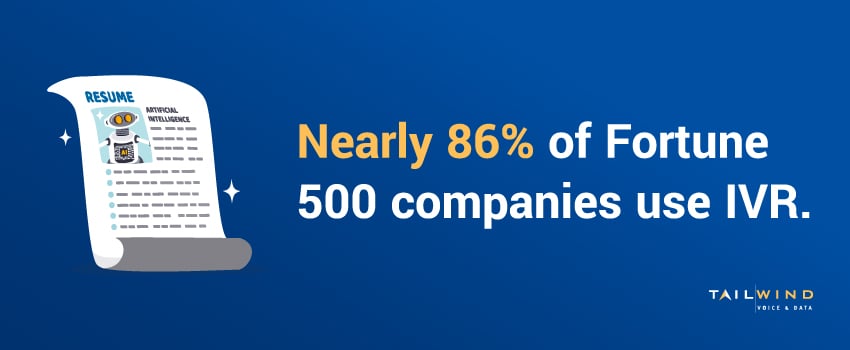
With IVR taking care of these basic tasks, human agents are freed up to handle the more complex and high-priority calls. Thanks to this capability, IVR systems have become a cornerstone of call centers – with nearly 86% of Fortune 500 companies using IVR as of 2025.1
How Does An IVR System Work?
An IVR system is a combination of telephony hardware or software, pre-recorded audio prompts, and call logic that governs how inbound calls are handled. Here's the basic flow of how a call moves through an interactive voice response system:
- Caller Dials In: The call reaches the IVR system, which answers immediately and plays the configured greeting and initial menu prompt.
- Input Is Captured: The caller responds by pressing a keypad digit (DTMF input) or, in more advanced systems, by speaking their response. Speech recognition IVR can interpret natural language – "I want to check my balance" – rather than requiring a specific menu option.
- IVR Applies Logic: The system processes the input against its programmed call flow, which may involve database lookups, account verification, or branching logic based on the caller's response.
- Call Is Resolved Or Routed: Either the IVR handles the request completely (self-service), or it routes the call to the appropriate agent, queue, or department based on the caller's selections and any data retrieved.
- Interaction Is Logged: IVR interactions generate data – call volumes by menu option, abandonment rates, self-service completion rates – that feed reporting and continuous improvement efforts.
The infrastructure that IVR systems run on matters as much as the software itself. A well-designed IVR call flow on an underpowered or poorly connected phone system still delivers a poor caller experience. Latency, audio quality, and system reliability are all functions of the underlying network and telephony infrastructure.
Key Benefits Of IVR In A Call Center Environment
IVR pays off on both sides of the call: callers reach answers faster, and your operation handles more volume at a lower cost per call. The benefits below matter most in a call center.
24/7 Caller Availability & After-Hours Self-Service
An IVR answers every call immediately, at 2 p.m. or 2 a.m. Callers can check a balance, track an order, or reset a PIN outside business hours, without waiting for the next available agent or a callback the following morning. For businesses with customers in multiple time zones, that always-on coverage turns after-hours volume from missed opportunities into resolved interactions.
Lower Call-Handling Costs & Higher Efficiency
Every call an IVR resolves on its own is a call an agent does not have to take. By automating routine, repetitive requests, IVR lowers the cost per interaction and lets your team spend its time on complex, high-value calls instead of password resets and store-hours questions. As call volume climbs, that automation absorbs the spikes without a matching jump in headcount.
Better Call Routing & First-Call Resolution
Because the IVR gathers each caller's intent before anyone picks up, it sends people to the agent best equipped to help them the first time. Accurate routing means fewer transfers, shorter handle times, and a higher first-call resolution rate. Callers spend less time repeating themselves, and agents start each conversation with the context they need.
Call Center IVR: How Interactive Voice Response Powers Contact Center Operations
The IVR call center relationship is deeply interdependent. For most contact centers, IVR is the first point of contact for every inbound caller – and the quality of that experience sets the tone for everything that follows.
Call Routing & Queue Management
The most fundamental IVR call center function is accurate call routing. When a caller selects "billing" from the main menu, they should reach a billing agent – not be transferred twice and put on hold.
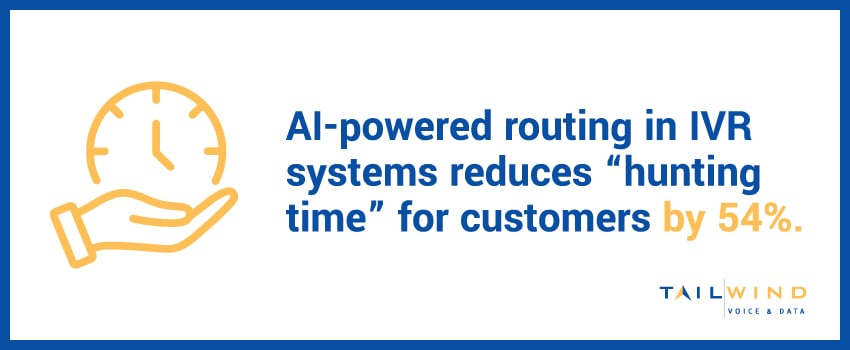
Proper IVR routing reduces misrouted calls, shortens handle time for agents, and improves first-call resolution rates. And AI makes this feature even more effective, with a 2025 study finding that AI-powered routing in IVR systems reduced “hunting time” for customers by 54%.2
For contact centers managing high inbound volumes, even a small improvement in routing accuracy has a measurable impact on cost per call.
Call Authentication & Caller Identification
IVR systems can authenticate callers before they ever reach an agent, collecting account numbers, PIN codes, or other verification inputs and cross-referencing them against CRM data.
Agents then receive the call with the caller already identified and verified, reducing average handle time and improving the experience for both the caller and the agent.
Self-Service Automation In The IVR Contact Center
Modern IVR contact center deployments do far more than route calls. Self-service functionality allows callers to complete routine tasks without ever reaching an agent, including:
- Account balance and payment processing inquiries
- Order status and tracking updates
- Appointment scheduling and confirmation
- Password resets and PIN changes
- FAQ responses and policy information delivery
Industry benchmarks show that a well-designed IVR can handle up to 80% of customer interactions without human intervention,3 directly reducing staffing costs and wait times.
Types Of Interactive Voice Response Systems
The right IVR system will depend on your call volume, the complexity of your call flows, and the level of natural language interaction you need to support. Here’s a quick look at the most popular types and what they’re best for:
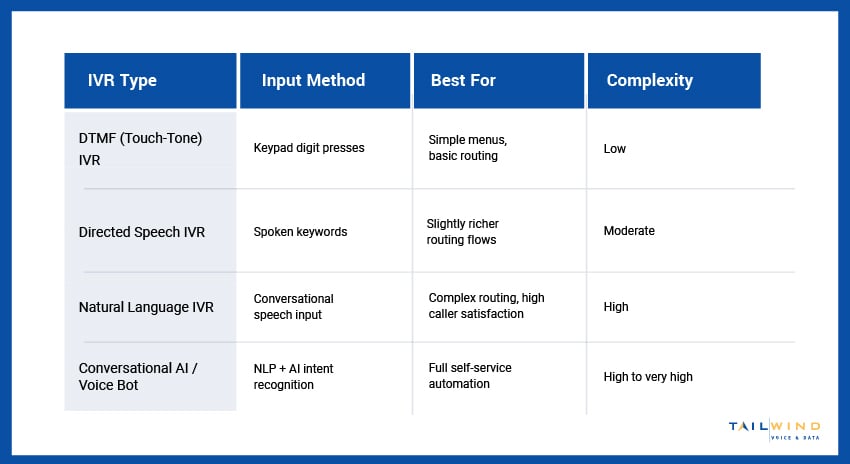
For enterprise contact centers, natural language IVR and conversational AI-powered systems represent the current standard for new deployments. DTMF-only systems still work reliably for simple applications but create friction for callers who expect a more intuitive experience.
IVR Use Cases & Examples Across Key Industries
IVR looks different depending on who is calling and why. The same core technology handles a hospital's appointment line and a bank's account hotline, but the menu, self-service tasks, and routing logic are built around each industry's most common requests. Here is how IVR typically shows up across the sectors that rely on it most:
-
Healthcare & Medical: Appointment scheduling and reminders, prescription refill requests, and routing to the right department, while sensitive calls reach a live staff member quickly.
-
Financial Services: Balance and transaction inquiries, secure caller authentication with an account number or PIN, fraud alerts, and after-hours access to routine account information.
-
Retail & Ecommerce: Order status and tracking, returns and exchange requests, store hours and locations, and overflow routing during peak shopping periods.
-
Utilities & Energy: Outage reporting, meter readings, and payment processing, so high call volumes during service events do not overwhelm live agents.
-
Professional & Field Services: Routing callers to the correct office or technician, capturing service requests, and offering a callback when no one is available.
A simple example shows how the logic works: a property management company runs a maintenance hotline where callers press 1 for an emergency, like a burst pipe, and reach on-call staff, or press 2 for a non-urgent request and leave a voicemail with their details. One menu keeps genuine emergencies moving while routine issues are captured cleanly for the next business day.
IVR Call Center vs IVR Contact Center: What’s The Difference?
A call center is voice-only. A contact center is omnichannel – handling voice, email, chat, SMS, and social in a unified operation. IVR systems, traditionally a voice-channel technology, have evolved to serve both.
- In an IVR Call Center Environment: IVR is the primary inbound routing and self-service engine.
- In an IVR Contact Center Environment: IVR integrates with omnichannel platforms to offer callers the option to switch to a digital channel, receive an SMS callback link, or authenticate once across channels. The IVR becomes part of a broader customer journey, not just a standalone call handler.
Businesses are migrating toward contact center IVR integration because callers increasingly expect seamless handoffs between voice and digital.
IVR Systems & The Infrastructure That Supports Them
An IVR system is only as reliable as the phone infrastructure it runs on. Here’s what enterprise organizations need to keep in mind when getting started with IVR:
SIP Trunking & VoIP Infrastructure
Most modern IVR systems, whether cloud-hosted or on-premises, connect to the PSTN via SIP trunks. SIP trunk capacity (concurrent call channels) must be sized to handle peak inbound volume without call rejection.
Businesses managing IVR across multiple locations need centralized SIP trunking to ensure seamless, simplified operations. That’s why at TailWind, we provide broadband aggregation and carrier services so that enterprises can right-size their voice connectivity across every location.
Network & Carrier Connectivity
IVR performance depends on voice quality, and voice quality depends on network performance – particularly with 78% of contact centers now using some form of high-bandwidth AI or automation.4
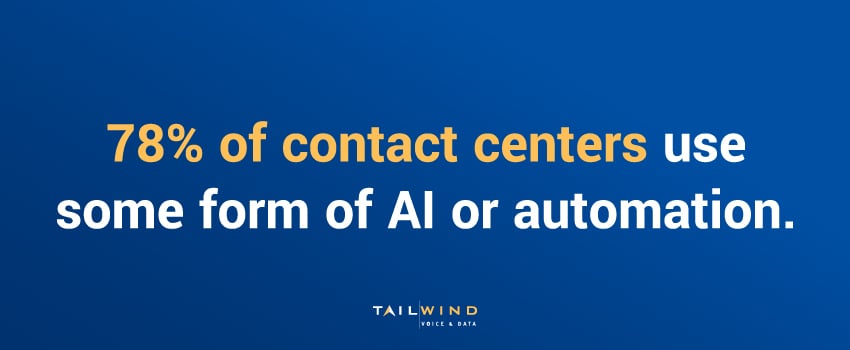
High latency, packet loss, or jitter on the network path between your carrier and your IVR platform degrades audio quality, causes recognition errors in speech-based IVR, and creates the choppy, frustrating call experience that drives callers to abandon.
TailWind’s dedicated internet access solutions ensure your connectivity layer is engineered for voice performance – not just data throughput.
On-Site Phone Infrastructure
For businesses deploying IVR as part of an on-prem or hybrid phone system, the physical infrastructure – wiring, switches, PBX hardware – must be properly installed and maintained to support the system reliably.
Poorly terminated cabling, underpowered switches, or misconfigured network equipment are common sources of IVR audio quality problems that get misattributed to the IVR software itself.
TailWind’s structured cabling and field services can help ensure your physical layer is built correctly from the start.
6 Interactive Voice Response Best Practices
Here's what separates a well-designed IVR system from one that frustrates your callers:
1. Keep Menus Short
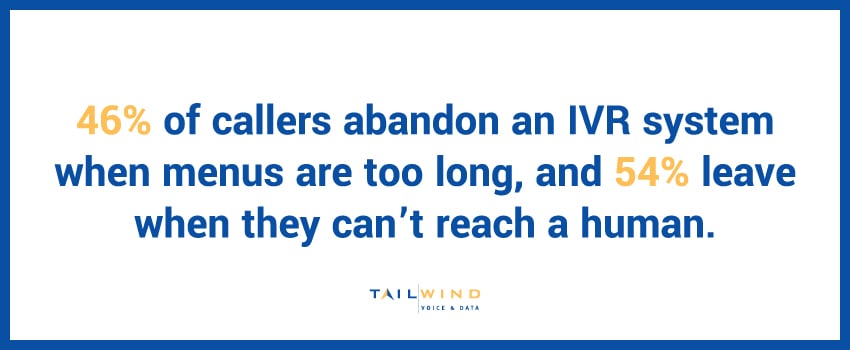
Nearly half (46%) of customers say long menus are their top reason for dissatisfaction with IVR systems.1 If your IVR has too many top-level options, it’s time to redesign it.
2. Put The Common Selections First
The menu item that most of your callers need shouldn't be option 4. Make sure to analyze your call volume by type and order your menu options by frequency.
3. Align Audio Quality With Brand Standards
Professionally-recorded prompts in a consistent voice and at a consistent volume reflect your company’s competence and care. Low-quality or inconsistent audio does the opposite.
4. Always Offer An Agent Escape
Difficulty reaching a live agent is the top reason for abandoning an IVR call for 54% of customers.1 Always include a “press 0” or "representative" option at every menu level.
5. Test With Real Callers Before Go-Live
If you’re only testing internally, you may miss the assumptions baked into your call flow design. Test with real-world callers who don't know the system first to reveal where people might be getting stuck.
6. Monitor & Iterate
Don’t just set-and-forget after launching your IVR. Review performance metrics like containment rate, per-menu abandonment, and routing accuracy regularly to drive ongoing optimization.
IVR Call Center FAQs
What Does IVR Stand For In A Call Center?
IVR stands for Interactive Voice Response. It is an automated telephony technology that greets callers, presents a menu, and gathers input through keypad presses (DTMF tones) or spoken responses. Based on that input, the IVR either resolves the request on its own, such as reading out an account balance, or routes the call to the right agent or department. In a call center, IVR is usually the first point of contact for every inbound caller, which makes it central to how quickly and accurately people get help.
How Does An IVR System Work?
An IVR system combines telephony hardware or software, pre-recorded or text-to-speech prompts, and call logic. When a caller dials in, the system answers immediately and plays a greeting and menu. The caller responds by pressing a key or speaking, and the IVR processes that input against its programmed call flow, which can include database lookups or account verification. From there, it either completes the request through self-service or routes the call to the appropriate agent or queue. Every interaction is logged, generating data that teams use to improve the system.
What Are The Main Benefits Of IVR In A Call Center?
The main benefits are availability, cost savings, and better routing. IVR answers calls 24/7, so customers can handle routine tasks outside business hours without waiting for an agent. By automating repetitive requests, it lowers the cost per call and frees agents to focus on complex issues. And because it captures caller intent upfront, it routes people to the right agent the first time, which shortens handle times and improves first-call resolution. Together, these let a call center handle more volume without a matching increase in staffing.
What Is An IVR Menu?
An IVR menu is the set of spoken options a caller hears when they reach an IVR system, such as press 1 for billing or press 2 for technical support. It can be a single level or a multi-level tree with nested submenus, and callers navigate it using keypad presses or voice commands. A well-designed menu keeps the top-level options short, orders them by how often callers need them, and always offers a clear path to a live agent.
What Are The Different Types Of IVR Systems?
There are four common types, increasing in sophistication. DTMF (touch-tone) IVR is the classic press-a-number system, reliable for simple menus. Directed speech IVR lets callers say specific keywords instead of pressing keys. Natural language IVR understands full spoken phrases, so callers can explain what they need in their own words. Conversational AI is the most advanced, handling back-and-forth dialogue and complex requests. The right type depends on your call volume, the complexity of your call flows, and how much natural-language interaction you want to support.
How Does IVR Differ In A Call Center vs A Contact Center?
The difference comes down to channels. A call center is voice-only, so IVR acts as the main inbound routing and self-service engine for phone calls. A contact center is omnichannel, handling voice, email, chat, SMS, and social in one operation, so IVR becomes part of a broader journey. In that setting, it can offer callers the option to switch to a digital channel, send an SMS callback link, or authenticate once across channels. The core technology is the same; the contact center simply connects it to more touchpoints.
Do Customers Prefer IVR Or Speaking To A Live Agent?
It depends on the task. For simple, routine needs like checking an order, making a payment, or getting store hours, most customers prefer the speed of IVR self-service over waiting in a queue. For complex, sensitive, or unusual issues, they want a person. The friction point is being trapped: difficulty reaching a live agent is a top reason callers abandon an IVR. The best systems offer both, fast self-service for easy tasks and an easy, always-available path to a human when it is needed.
Find A High-Performance IVR System With TailWind
Interactive voice response technology has matured significantly – today's IVR systems can handle complex call flows, integrate with CRM platforms, and process a meaningful share of contact volume without agent involvement. But even the best IVR system will still underperform if it's built on a poorly-designed phone infrastructure.
TailWind specializes in designing voice networks that deliver the performance your operations demand. We manage project coordination across locations, handle the technical execution, and provide ongoing support to keep your systems optimized as your business scales.
Ready to build network infrastructure that makes your IVR investment deliver? Get in touch with our team today!
Sources: