In-building cellular coverage issues create real business costs. Dropped calls interrupt critical communications, while connectivity dead zones can damage customer experiences and frustrate employees.
A distributed antenna system (DAS) is usually the right fix, which could be why over 55% of enterprise infrastructure projects now include DAS to ensure seamless communication.1 But not all DAS architectures work the same way, and choosing the wrong one can mean overspending on capacity you don't need, or underbuilding for a space that demands more.
In this guide, we’ll explain how active and passive DAS work and what to look for when choosing the right architecture for your facility, your budget, and your growth plans.
TL;DR
-
The core active vs passive DAS difference is how each moves signal: passive redistributes existing cellular signal over unpowered coaxial cable, while active converts it to fiber and powered remote units that scale across large buildings.
-
Passive DAS best fits buildings under about 100,000 square feet, while active DAS suits very large or high-density venues like stadiums, hospitals, and airports where added network capacity matters as much as coverage.
-
A hybrid DAS bridges active and passive, using a fiber backbone with passive coaxial distribution to extend coverage in mid-sized or multi-floor buildings that outgrow passive but cannot justify a full active build.
-
Active DAS costs significantly more and takes longer to deploy than passive, so the right choice depends on building size, the carriers you need to support, and long-term growth plans like 5G.
Active vs Passive DAS: A Head-To-Head Comparison
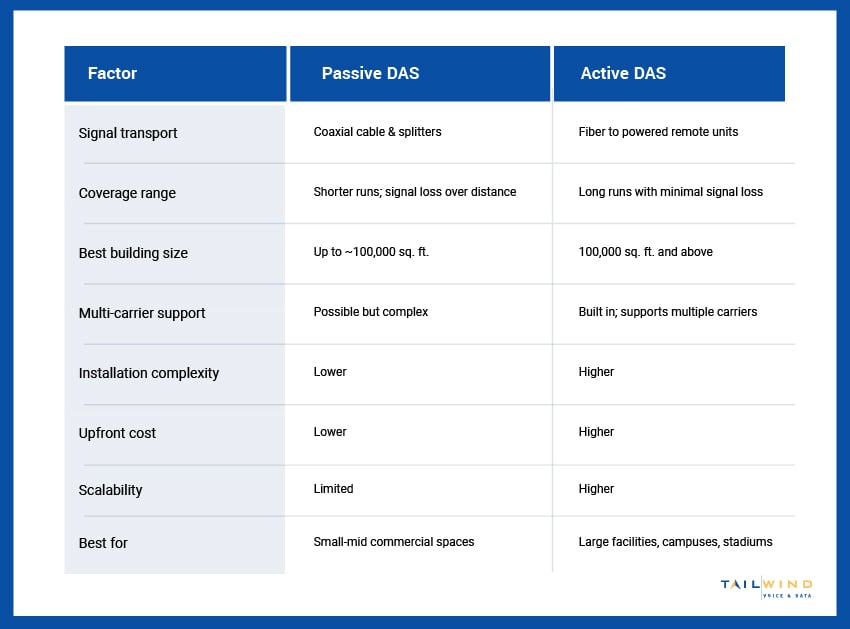
Here's how active and passive DAS stack up across the criteria that matter most for enterprise deployments:
How Does Passive DAS Work?
A passive DAS distributes cellular signal using unpowered (passive) components: coaxial cable, splitters, taps, and couplers. Signal enters the system from a donor antenna or small cell, travels through the coax network, and is broadcast by antennas positioned throughout the building. No active electronics are required between the head-end and the antennas.
Passive DAS Advantages
- Lower Cost: Fewer components and no powered remote units mean lower equipment and installation expenses.
- Simpler Deployment: Because there are fewer moving parts to configure, passive DAS is faster to install and commission.
- Lower Maintenance: No powered components outside the head-end means fewer potential failure points.
Passive DAS Limitations
The physics of coaxial cable is the biggest obstacle when deploying passive DAS at scale. Coverage is typically limited to buildings under 100,000 square feet, because long cable runs degrade signal quality and cap performance. You simply can't push enough signal through a passive system to cover large or complex enterprise spaces effectively.
How Does Active DAS Work?
An active DAS uses fiber-optic cable and distributes powered remote units (RUs) throughout the building. The head-end digitizes or converts the RF signal, sends it over fiber to each remote unit, and the RU reconverts and broadcasts it locally. Because fiber introduces virtually no signal loss over distance, an active system can cover larger environments that would be impossible for a passive architecture.
Active DAS Advantages
- Scalable Coverage: Fiber can run for hundreds or thousands of feet with no meaningful signal degradation.
- Multi-Carrier Ready: An active DAS system can support multiple carriers – AT&T, Verizon, T-Mobile – without redundant cabling for each.
- Future-Proof: Adding new bands or expanding coverage is handled largely through head-end and RU upgrades rather than pulling new cable.
- Centralized Monitoring: Active systems typically include management software that provides real-time visibility into health and performance.
Active DAS Limitations
The power and flexibility of active DAS come at a price – literally. Equipment costs are significantly higher, installation requires more skilled labor and longer timelines, and the system has more components that can require service. For smaller buildings, that investment doesn't pay off. For large facilities where coverage performance and multi-carrier support are non-negotiable, it's the right architecture.
What Is Hybrid DAS & When Does It Fit Best?
Active and passive are not the only two options. A hybrid DAS blends both: it uses fiber-optic cable for the long backbone runs, like an active system, then switches to passive coaxial cable and antennas for distribution at the edge. That combination buys you more reach than a purely passive system without the full equipment cost and complexity of a fully active build.
Hybrid works well when a building sits in the awkward middle: too large or too spread out for passive alone, but not dense or sprawling enough to justify a full active deployment. Multiple passive zones can be linked back to a central point over fiber, which extends coverage across floors or wings that coax alone could not reach cleanly.
A hybrid DAS is often the right fit for:
-
Mid-sized and multi-floor buildings that push past passive's practical coverage limits
-
Campuses or facilities with a few separated areas that each need their own coverage zone
-
Projects that need more than passive can deliver but cannot absorb full active pricing or timelines
-
Older or irregular buildings where a single cable type struggles with the layout
The trade-off is straightforward: a hybrid system costs more and takes more planning and up-front system design than passive, but less than active. For many enterprise facilities that fall between the two extremes, it is the most cost-effective way to get reliable, building-wide cellular coverage.
Passive vs Active DAS vs Wi-Fi Differences
Can a strong WiFi deployment replace the need for DAS entirely? The short answer is no, but understanding why clarifies where each technology belongs.
- WiFi operates on unlicensed spectrum and requires a device to be actively connected to your network.
- DAS operates on licensed carrier frequencies, meaning it improves cellular performance for every person in the building, regardless of whether they're on your WiFi.
In environments like hospitals, warehouses, and large offices, both are necessary and complementary. Not sure which system your business needs? TailWind’s Business WiFi services can help you assess your connectivity needs and install the infrastructure your systems depend on.

How To Choose The Right Active DAS vs Passive DAS System
The decision between active and passive DAS typically comes down to these four factors:
Building Size
For a facility under 100,000 sq. ft. or with a simple layout, passive is usually sufficient and cost-effective. If it’s over 100,000 sq. ft., multi-floor, or a complex construction, active is the more reliable path.
Network Capacity & Peak Concurrent User Density
Coverage and capacity are not the same problem. A passive DAS improves signal reliability in dead zones, but it does not add network capacity, so it can still buckle when thousands of people connect at once. Active DAS adds capacity and sustains high concurrent-user densities, which is why stadiums, arenas, convention centers, and busy transit hubs rely on it. If your facility sees dense crowds at peak times, size the system to peak simultaneous devices, not just floor area.
Carrier Support
If you need to support multiple carriers under one system – especially important for large or public-facing facilities – active DAS is built for that. Passive systems can support multiple carriers, but this will require more complex RF engineering.
Budget & Timeline
Passive systems are faster and less expensive to deploy. If coverage requirements can be met with passive architecture, that may be the pragmatic choice. Active systems require more planning, more lead time, and more capital.
Future Requirements
If your organization is growing, if you anticipate 5G requirements, or if you're building infrastructure intended to serve the facility for 15+ years, the scalability of active DAS often justifies the upfront investment.

Active vs Passive DAS FAQs
Does Passive DAS Add Network Capacity?
No. A passive DAS rebroadcasts existing cellular signal to fix dead zones and weak coverage, but it does not add network capacity. That means it improves reliability for the users already connecting, yet it cannot help a crowded space support more simultaneous connections. When a building fills with thousands of people at peak times, like a stadium or convention center, passive coverage alone can still slow down. Adding capacity for high concurrent-user density is a job for an active DAS, which manages signal through powered remote units built to handle heavy load.
What Is Hybrid DAS?
A hybrid DAS combines active and passive design in one system. It uses fiber-optic cable for the long backbone runs, the way an active system does, then distributes signal through passive coaxial cable and antennas at the edge. This gives a building more coverage reach than pure passive can manage, without the full equipment cost and complexity of a fully active deployment. Hybrid systems suit mid-sized, multi-floor, or irregular buildings that fall between the two extremes, where passive alone runs short but a complete active build is more than the facility needs.
Is A Passive DAS The Same As A Cell Phone Signal Booster?
They are closely related, and the terms often overlap. A passive DAS uses a rooftop donor antenna to capture outside cellular signal, a bi-directional amplifier (BDA) to boost it, and passive components like coaxial cable and splitters to spread it indoors. A cell phone signal booster (also called a BDA system) works on the same principle, which is why many people use the labels interchangeably. The main difference is scale: booster is the common term for smaller setups, while passive DAS usually describes a larger, professionally designed distribution across a commercial building.
How Long Does It Take To Install An Active vs Passive DAS?
A passive DAS is usually the faster deployment, often measured in weeks. It has fewer components, no powered remote units to configure, and a simpler design and commissioning process. An active DAS takes longer, commonly months, because it involves more equipment, fiber runs, powered remote units, skilled labor, and detailed system design across the building. The exact timeline depends on facility size, layout, and how many carriers you need to support. For projects with tight deadlines, passive can be the pragmatic choice when it meets the coverage requirement.
How Much Does Active vs Passive DAS Cost Per Square Foot?
Active DAS costs significantly more per square foot than passive, often several times more. The gap comes from active DAS equipment: powered remote units, fiber-optic cabling, head-end electronics, monitoring software, and the skilled labor to install and commission it all. Passive DAS relies on lower-cost, unpowered components like coaxial cable, splitters, and couplers, which keeps both equipment and installation expenses down. For smaller buildings, passive usually delivers the coverage you need at a fraction of the cost. For very large or high-density facilities, active DAS is the investment that actually meets the requirement.
What Is The Maximum Coverage Area Of A Passive DAS?
Passive DAS is typically best for buildings up to around 100,000 square feet, such as retail stores, hotels, and small to mid-sized offices. The limiting factor is coaxial cable: signal loss increases the further antennas sit from the amplifier, so long cable runs degrade performance. Larger passive deployments are possible by adding more amplifiers and antenna zones, but coax physics still caps how far and how cleanly a passive system can reach. Once a facility grows past that practical limit, or its layout gets complex, active or hybrid DAS becomes the more reliable path.
Do Active And Passive DAS Support 5G?
Yes, both can support 5G, though the details matter. Passive DAS can carry the cellular bands your carriers broadcast, including many 5G frequencies, as long as the components and amplifier are rated for them. Active DAS is generally the more future-ready choice for 5G at scale, because adding new bands or expanding coverage is handled largely through head-end and remote-unit upgrades rather than pulling new cable. If 5G capacity for dense user loads is a priority, or you are building infrastructure to last 15 years or more, active DAS gives you more room to grow.
Find The Right-Fit DAS Architecture With TailWind
Active and passive DAS both solve the in-building cellular coverage problem – but for very different types of facilities and budgets. Getting to the right answer requires an honest assessment of your space, carriers, and long-term infrastructure plans.
Regardless of which type, DAS performance depends on properly installed, certified cabling – the same discipline that drives TailWind’s structured cabling and field services work across enterprise deployments nationwide.
If you're working through a DAS decision for a single facility or a multi-location portfolio, we're here to help you think through the infrastructure side of the equation. Get in touch with our team and let's figure out the right fit for your environment.
Sources: