
Choosing the right network design is a major part of keeping your business connected and productive. But while many organizations focus on WiFi, switches, or firewalls, the part of your network that ties everything together often gets less attention.
That part is the backhaul. When your backhaul network is strong, your locations, applications, and users stay in sync. When it’s not, you experience slowdowns, outages, and inconsistent performance across your sites.
At TailWind, we help businesses across the country deploy, manage, and optimize networks at scale, including building backhaul connections that deliver consistent performance from edge to core. In this guide, we’ll break down what backhaul is, how it works, and what to consider when building or upgrading your connectivity strategy.
TL;DR
-
Backhaul networking connects local access points, branch sites, and edge devices back to the core network, data center, or internet.
-
Backhaul can use fiber, Ethernet, microwave, wireless, or satellite connections depending on location, performance needs, and available infrastructure.
-
Strong backhaul helps prevent bottlenecks that can slow down cloud applications, VoIP, video meetings, Wi-Fi, and multi-site networks.
-
For business networks, the right backhaul design improves reliability, scalability, latency, security, and overall network performance.
What Is Backhaul?
Backhaul refers to the part of your network that carries data from the access layer to a central location (such as a data center). Edge devices like access points, switches, routers, branch offices, and remote equipment all depend on backhaul to reach the main network or the internet.
In practical terms, backhaul links your local area network to your internet or private WAN connection. When your backhaul is strong, your sites can share data easily, cloud apps load more consistently, and employees experience fewer interruptions.
What Is Wireless Backhaul?
Wireless backhaul uses radio technologies such as RF, microwave, or millimeter wave to move data between locations without cables. It is often used in environments where laying fiber is difficult, expensive, or time-sensitive. Construction sites, rural areas, temporary buildings, and facilities where trenching is not an option frequently use wireless backhaul.
A wireless backhaul setup typically includes point-to-point or point-to-multipoint antennas that link remote sites or access points back to the network core. It offers quick deployment and wide coverage, which makes it useful for organizations that need flexibility or fast rollout timelines.
Wireless backhaul can, however, experience interference from weather or physical obstructions. Bandwidth may also be lower than wired alternatives. Because of this, many businesses use wireless backhaul as a supplement rather than a primary transport path.
At TailWind, we often recommend a blended approach when customers need fast installation or when location conditions prevent traditional wiring.
What Is Ethernet Backhaul?
Ethernet backhaul uses physical cabling (typically fiber or copper) to connect network nodes. It offers:
- High reliability
- Low latency
- Greater bandwidth capacity
- Improved security
So, what is Ethernet backhaul used for? It’s common in enterprise LANs and Wi-Fi networks where access points are hardwired back to the main switch or controller. It’s also widely used for Metro Ethernet or MPLS networks that connect multiple business locations.
Unlike wireless, Ethernet backhaul requires more extensive infrastructure and installation planning – but for businesses that need high levels of performance and consistency, it’s usually the preferred option.
The Difference Between Wired & Wireless Backhaul
Here’s a quick comparison of the two main backhaul types:
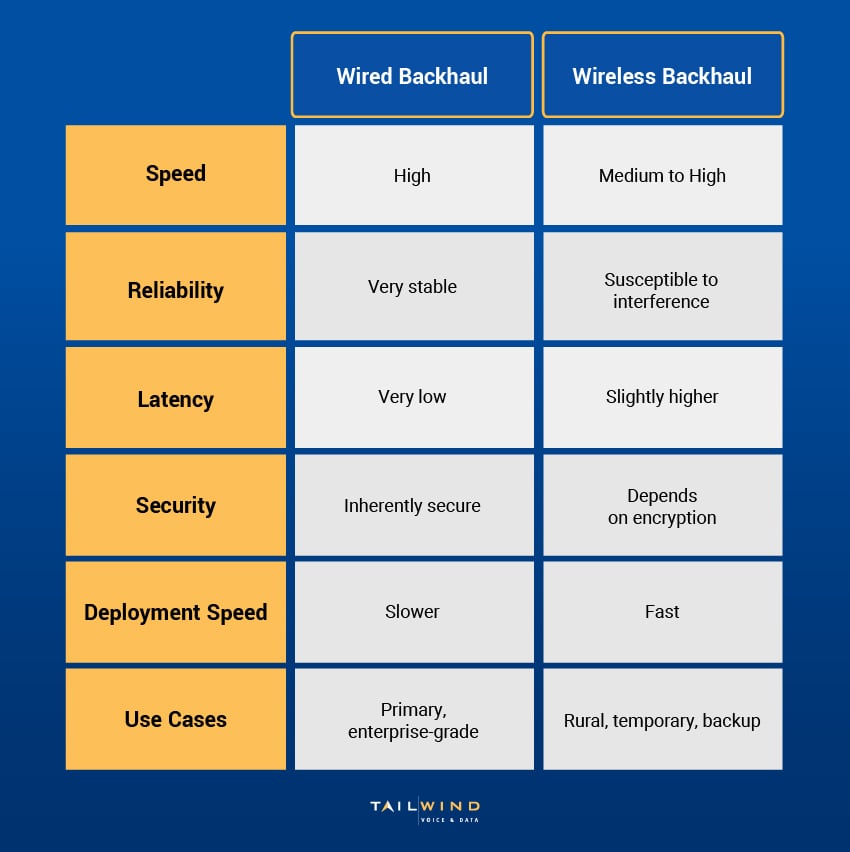
Many organizations use both. A primary fiber or Ethernet backhaul may serve the main location, while wireless backhaul provides redundancy or extends service to hard-to-reach sites.
Common Types Of Backhaul Connections
Backhaul can be delivered through several types of connections, depending on the location, performance requirements, available infrastructure, and rollout timeline. In many business environments, the right choice is not just about speed. It also depends on reliability, cost, installation complexity, and how critical the site is to daily operations.
Fiber Optic Backhaul
Fiber optic backhaul is often the preferred option for high-capacity environments because it delivers strong bandwidth, low latency, and consistent performance over long distances. It is commonly used for enterprise locations, dense business areas, data centers, and networks that support cloud applications, VoIP, video, and other traffic-sensitive systems.
For organizations that need predictable performance, fiber provides a strong foundation. The tradeoff is that it may require more planning, construction, or carrier coordination, especially when fiber is not already available at the site.
Microwave & Wireless Backhaul
Microwave and other wireless backhaul options are useful when physical cabling is difficult, expensive, or too slow to deploy. These links can connect buildings, remote sites, towers, or temporary locations without trenching or new cable pathways.
Wireless backhaul can be a practical option for rural areas, construction environments, hard-to-reach facilities, or backup connectivity. However, performance can depend on distance, line of sight, weather conditions, and interference. That is why wireless backhaul is often designed carefully around the environment where it will be used.
Satellite Backhaul
Satellite backhaul is typically used when fiber, Ethernet, or terrestrial wireless options are not available. It can support remote sites, offshore locations, field operations, or facilities where traditional infrastructure is limited.
While satellite can extend connectivity into difficult locations, it may come with higher latency and different performance limitations than fiber or terrestrial wireless. For that reason, it is usually considered when other backhaul options are not practical or when coverage matters more than ultra-low latency.
What Is A Backhaul Network?
A backhaul network consists of the transmission links – wired or wireless – that connect access networks (like Wi-Fi, cellular, or branch offices) to core networks or the internet.
It’s often referred to as “middle mile” infrastructure and may include:
- Fiber optic cables
- Ethernet switches
- Microwave or mmWave radios
- Aggregation points
- Transport routers
A strong backhaul network ensures that end users experience consistent performance, even during high usage periods or across geographically dispersed locations.
At TailWind, we design, install, and manage custom backhaul solutions that align with your bandwidth needs and reliability goals – so your middle mile doesn’t become a bottleneck.
Real-World Examples Of Backhaul Networking
Backhaul is easier to understand when you look at where it shows up in everyday networks. Whether the environment is a branch office, a wireless network, or a larger service provider network, the basic role is the same: backhaul carries traffic from the access point back to the larger network that supports it.
Mobile Backhaul In Cellular Networks
In a cellular network, your phone connects to a nearby cell tower through the access network. From there, the tower still needs a high-capacity connection back to the provider’s core network and the internet. That connection is mobile backhaul.
If the backhaul connection behind the tower is congested, users may experience slow speeds, dropped calls, or poor application performance, even if the wireless signal looks strong. This is one reason backhaul is so important for modern cellular and 5G networks.
Mesh Wi-Fi Backhaul
Backhaul also plays a role in mesh Wi-Fi systems. In a mesh network, each access point or node helps extend wireless coverage across a larger space. But those nodes still need a way to communicate with the main router, switch, or controller.
That connection is the mesh backhaul. It may run wirelessly between nodes, or it may use Ethernet cabling for stronger performance. In business environments, wired backhaul is often preferred where possible because it gives access points a more stable path back to the network.
ISP & Exchange Backhaul
Internet service providers also rely on backhaul to move traffic from local access networks toward larger aggregation points, exchanges, and internet gateways. In this context, backhaul helps connect neighborhoods, business districts, or regional service areas to the broader internet.
For businesses, this matters because the performance of the provider’s backhaul can affect the quality of the service delivered to each site. A fast local connection still depends on the upstream network behind it.
7 Reasons Why Backhaul Matters For Business Networks
Backhaul plays a larger role in network performance than many teams realize. Without it, your internet, cloud apps, VoIP systems, and VPNs can all suffer.
Here’s why the right backhaul network makes a difference:
1. Ensures Quality of Service (QoS)
With the right configuration, backhaul can prioritize critical business traffic like voice or real-time applications so your communications stay clear and your systems stay responsive.
2. Scales With Your Growth
Growing businesses often add users, devices, or entire sites. A flexible backhaul strategy helps you expand without losing performance.
3. Reduces Downtime
Redundant or diverse backhaul paths can prevent single points of failure in your network and boost uptime – a key metric for any business that depends on constant connectivity.
4. Supports Remote & Hybrid Work
Distributed workers need secure, reliable access to cloud apps and internal systems. Backhaul links those systems together so teams can work effectively from anywhere.
5. Supports Cloud Performance
Backhaul influences how smoothly cloud apps run because it carries traffic between locations and the cloud. When backhaul capacity is strong, users experience fewer delays, faster loading times, and more consistent performance during busy hours.
6. Improves Visibility & Troubleshooting
A well-designed backhaul path provides more insight into how traffic flows across your network. Better visibility reduces guesswork, shortens resolution time, and lets your teams take a proactive approach to performance and reliability.
7. Enhances Security Across Locations
Backhaul often carries sensitive information between sites or from remote offices to central systems. Secure backhaul paths help data stay protected as it moves across the network. When combined with encryption, segmentation, and proper routing controls, backhaul becomes an important part of your organization’s overall security posture.
Backhaul Networking FAQs
What Is Backhaul In Networking?
Backhaul in networking is the part of the network that carries traffic from the access layer back to the core network, data center, private WAN, or internet connection. It connects local users, branch offices, access points, routers, and other edge devices to the larger network behind them.
When backhaul is designed well, traffic moves consistently between sites, cloud platforms, and business systems. When it is weak, congested, or unreliable, users may experience slow applications, poor call quality, dropped connections, or inconsistent performance.
What Is The Difference Between Backhaul And The Access Network?
The access network is the part users and devices connect to directly, such as Wi-Fi, a local switch, or a cellular tower. Backhaul is the connection behind that access layer that carries traffic back to the core network or internet.
A simple way to think about it is this: the access network gets users connected, while backhaul moves their traffic where it needs to go. Both matter, but backhaul often determines whether the overall experience feels fast, stable, and reliable.
What Are The Main Types Of Backhaul Connections?
The main types of backhaul connections include wired options, such as Ethernet and fiber, and wireless options, such as microwave, RF, millimeter wave, or satellite. The right choice depends on the location, bandwidth needs, performance requirements, and available infrastructure.
Many businesses use a mix of backhaul technologies. For example, a primary fiber or Ethernet connection may support the main network, while wireless backhaul provides redundancy or connects hard-to-reach locations.
Why Is Backhaul Important For Business Networks?
Backhaul is important because it affects how well internet, cloud applications, VoIP systems, VPNs, and multi-location networks perform. Even if a business has strong Wi-Fi or modern network equipment, performance can still suffer if the backhaul connection is undersized or unstable.
For growing organizations, backhaul also supports scalability. As users, devices, applications, and locations increase, the backhaul network needs enough capacity and reliability to keep everything connected.
Can Backhaul Affect Cloud Application Performance?
Yes. Backhaul plays a direct role in how smoothly cloud applications perform because it carries traffic between users, locations, and cloud services. If the backhaul path is congested, cloud-based tools may load slowly, lag during busy periods, or feel inconsistent across different sites.
A strong backhaul design helps reduce delays and gives business-critical applications a more reliable path across the network. This is especially important for organizations that depend on real-time tools like VoIP, video meetings, hosted desktops, and collaboration platforms.
Is Wired Backhaul Better Than Wireless Backhaul?
Wired backhaul is usually preferred when a business needs maximum reliability, low latency, and high bandwidth. Fiber and Ethernet connections are common choices for enterprise locations, Wi-Fi networks, and multi-site environments that need predictable performance.
Wireless backhaul can still be the better option when speed of deployment, physical access, or site conditions make cabling difficult. It is often used for rural locations, temporary environments, remote sites, or redundant paths. In many cases, the best design uses both.
Optimize Your Backhaul Network With TailWind
Backhaul might work behind the scenes, but every user, app, and site across your organization can feel its impact. By investing in the right backhaul architecture, you can deliver fast, reliable service where it matters most – at the edge.
Whether you’re refreshing your infrastructure or starting from scratch, backhaul needs to be part of your strategic plan. At TailWind, we help multi-location organizations:
- Audit existing backhaul infrastructure
- Identify areas of congestion or instability
- Choose the best backhaul technologies for each site
- Deploy and manage wireless and wired options
Our nationwide field service team handles everything from cabling and antenna installation to testing and optimization, ensuring your backhaul supports today’s needs and tomorrow’s growth.
Ready to see how TailWind can support your connectivity goals? Contact us today to get started!