Walk into a hospital, convention center, or stadium and try to make a call. In many of these environments, your phone will show full bars, but the call still drops, and messages take minutes to send. The problem isn't your carrier. It's the building.
Dense construction materials like concrete, steel, and low-emissivity glass absorb and block cell signals before they ever reach your device. A distributed antenna system (DAS) is the engineered solution to that problem, and for enterprises operating in large or complex facilities, it's one of the most important infrastructure investments they can make.
Read on to learn how distributed antenna systems work and why they should matter for your enterprise.
TL;DR
-
A distributed antenna system (DAS) is a network of small, spatially separated antennas fed from a common signal source, spreading reliable cellular coverage across a building or area.
-
DAS exists because dense building materials, large or underground spaces, and high-traffic congestion all block or overwhelm the outdoor cell signal that would otherwise reach devices inside.
-
DAS is classified by deployment (indoor iDAS or outdoor oDAS) and by architecture (passive, active, hybrid, or digital), matched to building size, carriers, and budget.
-
Unlike a plug-in signal booster, a DAS is engineered to support high device densities and hold performance for thousands of simultaneous connections, and its reliability depends on properly installed cabling.
What Is A DAS System?
A DAS system is made up of spatially separated antenna nodes connected to a common signal source, designed to distribute wireless coverage evenly across a large area. Rather than relying on a single powerful antenna or an outdoor cell tower to punch a signal through walls and floors, a DAS places smaller antennas throughout a building to bring the signal directly to where people are.
The result is reliable cellular coverage in environments where it would otherwise be degraded or absent altogether, which could be why more than 55% of large-scale infrastructure projects use DAS to ensure seamless communication.1 A well-designed DAS supports voice calls, LTE, 5G data, and – in public safety configurations – the emergency responder radio communications required by building codes in many jurisdictions.
Why Buildings Need A DAS For Cellular Coverage
Cellular service that works fine outside often falls apart the moment you walk indoors, and the cause usually is not your carrier. Three problems drive the need for a DAS:
-
Building materials block the signal: Concrete, steel, and low-emissivity (energy-efficient) glass absorb and reflect cellular signals before they reach your device. The more modern and energy-efficient the construction, the worse the problem tends to become.
-
Large and underground spaces create dead zones: Sprawling floor plans, thick interior walls, basements, and parking levels leave pockets with little or no reception, regardless of how strong the signal is just outside the building.
-
High-traffic venues overload the network: When thousands of people in one place compete for the same nearby cell tower, the network congests and data speeds collapse, even in spots where coverage technically exists.
A DAS addresses all three at once by placing distributed antennas throughout the building and feeding them from a strong, dedicated signal source, so coverage stays consistent from the lobby to the loading dock.
DAS Components: What Makes Up A DAS Network
A DAS network is composed of several interdependent components. Each plays a specific role in getting a signal from the source to the end user.
Signal Source
The signal source is where the DAS gets its radio frequency (RF) input. This can be a connection from an outside donor antenna pointed at a carrier tower, a small cell or base transceiver station (BTS) installed on-premises, or a carrier-provided head-end unit. The source determines which frequencies and carriers the system supports.
Head-End Equipment
Head-end equipment is the hub of the system. It receives the signal from the source, processes it, and prepares it for distribution throughout the building. In active and digital DAS configurations, the head-end also handles signal digitization, monitoring, and management.
Distribution Network
The distribution network carries the processed signal from the head-end to the remote antenna units. Depending on the DAS type, this may be coaxial cable (passive DAS), fiber-optic cable (active or digital DAS), or a combination of both.
Cabling Infrastructure
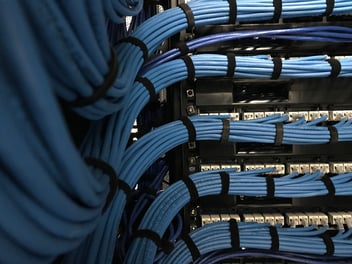
Cabling infrastructure is where proper installation standards – the same ones that govern structured cabling deployments – matter most. Poorly installed or incorrectly terminated cable is one of the most common causes of DAS underperformance. At TailWind, our structured cabling team installs and certifies the distribution infrastructure that DAS systems depend on.
Remote Units & Amplifiers
Remote units (RUs) or remote radio heads receive the distributed signal and amplify it for local broadcast. In passive systems, this role is handled by the coaxial cable network and splitters. In active systems, powered remote units convert and rebroadcast the signal electronically, enabling much longer distribution runs without signal degradation.
DAS Antennas
DAS antennas radiate the RF signal into the coverage area. These are typically small, low-profile, omnidirectional units designed to blend into commercial interiors. Placement, count, and power levels are determined during the RF design phase of the project.
How Does A Distributed Antenna System Work?
Understanding DAS starts with its signal flow. At a high level, every distributed antenna system works like this:
- A signal source, either from the carrier's network or an on-site base station, feeds into the DAS
- That signal is distributed through coaxial cable, fiber, or a combination of both
- Remote units or amplifiers condition and amplify the signal along the way
- Antenna nodes throughout the building receive and rebroadcast the signal at appropriate power levels
- Devices connect to whichever antenna node has the strongest signal, just as they would with a cell tower
The key difference from simply adding a signal booster is scale, precision, and capacity. A DAS is engineered to cover specific areas at specific signal levels, support high device densities, and maintain performance even when hundreds or thousands of devices are connected simultaneously – something a consumer booster simply can’t do.
Indoor DAS vs Outdoor DAS: iDAS & oDAS Explained
DAS is classified two ways, and it helps to keep them separate. The four architectures covered below (passive, active, hybrid, and digital) describe how a system moves signal. Where a system is deployed is a different question, and it splits DAS into two categories:
-
Indoor DAS (iDAS): Built inside structures like offices, hospitals, high-rise buildings, and warehouses, an indoor DAS brings signal directly to the areas where people work and gather. This is the deployment type the rest of this guide focuses on, and the one most enterprises are asking about when they consider DAS.
-
Outdoor DAS (oDAS): Deployed across open areas like corporate campuses, stadiums, and city streets, an outdoor DAS uses antennas mounted on poles, rooftops, or existing street furniture to blanket a wide area. It is often used to fill coverage gaps between cell towers or to add capacity across a large outdoor footprint.
Most DAS deployments combine one of these deployment categories with one of the four architectures below, matched to the building, the carriers, and the coverage goal.
4 Types Of Distributed Antenna Systems
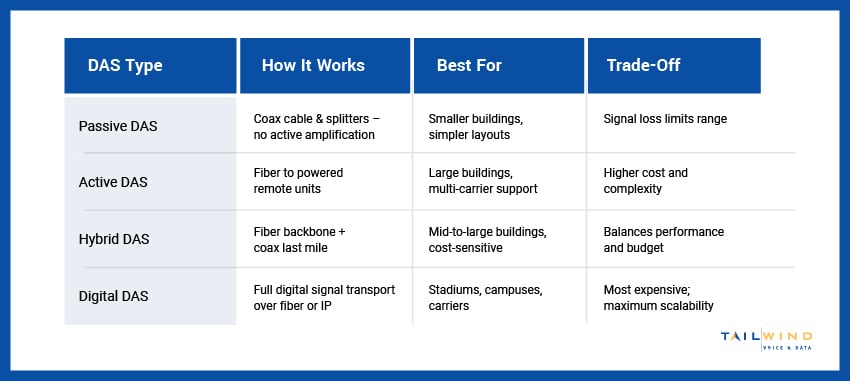
The right architecture for your DAS network depends on building size, coverage requirements, carrier coordination needs, and budget. Here's how the four primary types compare:
1. Passive DAS
In a passive distributed antenna system, the signal travels from the head-end through a network of coaxial cable, splitters, and couplers, with no active amplification between the source and the antenna.
Passive systems are simpler and less expensive to install, but signal loss will accumulate over longer distances. They're best suited to smaller buildings or environments with fewer floors and shorter cable runs.
2. Active DAS
Active DAS systems convert the RF signal to optical or digital format at the head-end, transport it over fiber to remote units, and reconvert it for local broadcast.
Because fiber introduces virtually no signal loss over distance, active systems can cover large, complex environments more effectively. They also support multiple carriers on a single infrastructure. The trade-off here is higher equipment cost and a more complex installation.
3. Hybrid DAS
Hybrid systems combine a fiber backbone from the head-end with a coaxial last-mile distribution to the antennas. This approach captures much of the range advantage of active DAS while reducing the per-port cost of deploying powered remote units at every antenna location.
For many mid-size commercial deployments, hybrid DAS hits the right balance of performance and cost.
4. Digital DAS
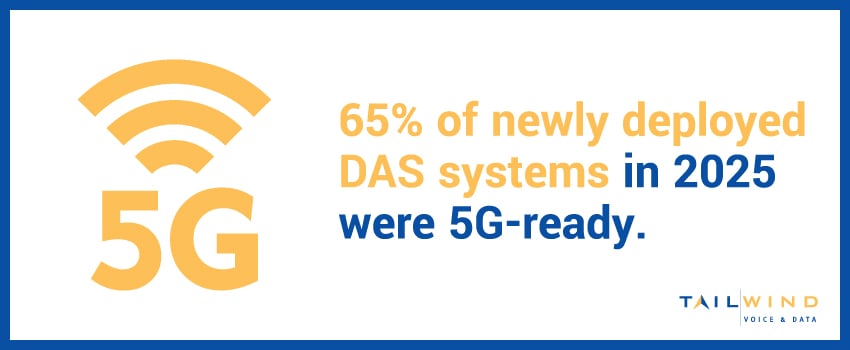
Digital DAS (D-DAS) transports the signal in fully digitized form. This enables advanced features like precise power control per antenna, real-time monitoring, and support for emerging radio technologies, with 65% of newly deployed DAS systems in 2025 5G-ready.2
D-DAS is the architecture of choice for large-scale, carrier-grade deployments such as airports, stadiums, and urban high-rises where multiple carriers and very high device densities must be supported simultaneously.
Where Does An Indoor Distributed Antenna System Make The Most Impact?
The most common use cases for an indoor distributed antenna system include:
- Healthcare Facilities: DAS provides reliable cellular connectivity for staff communication, patient devices, and increasingly, clinical IoT equipment – while also meeting public safety radio requirements for first responders.
- Multi-Tenant Office Buildings: Tenants expect cellular coverage as a baseline amenity. DAS systems let building owners guarantee it, giving them a competitive advantage in leasing.
- Retail and Hospitality: Customer-facing businesses depend on cellular service from DAS networks for payment systems, staff communications, and guest experience.
- Warehouses: Large industrial footprints with metal racking and concrete walls are notoriously difficult for cellular signals to penetrate. DAS solves coverage problems that WiFi alone can't address.
- Emergency Response: Many jurisdictions now require buildings above a certain size to have a dedicated public safety DAS – an ERRCS (Emergency Responder Communication Enhancement System) – to make sure first responders can communicate inside the building.
The infrastructure that supports DAS in all of these use cases – structured cabling, fiber backbone runs, and coordinated deployment across sites – is exactly the kind of work TailWind’s nationwide field services team handles every day.
DAS Antenna vs WiFi: Complementary, Not Competing
A common question is whether a strong WiFi deployment eliminates the need for a DAS. The short answer is no – they solve different problems.
WiFi operates on unlicensed spectrum (2.4 GHz and 5 GHz) and delivers data connectivity for devices connected to your local network. A business WiFi deployment addresses internal data connectivity.
A DAS operates on licensed carrier spectrum and supports cellular calls, SMS, and carrier data – including for guests, visitors, and contractors who aren't on your WiFi network. In environments like hospitals, warehouses, and large office buildings, both are necessary.
Distributed Antenna System (DAS) FAQs
What Is A Distributed Antenna System (DAS)?
A distributed antenna system (DAS) is a network of small, spatially separated antennas connected to a common signal source, working together to spread reliable cellular coverage across a building or area. Instead of relying on one powerful antenna or a distant cell tower to push signal through walls, a DAS places smaller antennas throughout a space to bring the signal directly to where people are. It supports voice calls, LTE, and 5G data, and in public safety configurations, the emergency responder radio coverage many building codes require.
Why Do Cell Signals Fail Inside Buildings?
Three things get in the way. First, dense building materials like concrete, steel, and low-emissivity glass absorb and reflect cellular signals before they reach your device. Second, large or underground spaces (sprawling floor plans, basements, parking levels) create dead zones with little or no reception. Third, high-traffic venues overload the nearest cell tower when thousands of people compete for the same signal, so speeds collapse even where coverage exists. A DAS addresses all three by distributing a strong, dedicated signal throughout the building.
What Are The Main Types Of DAS?
DAS is classified two ways. By architecture, there are four types: passive (coaxial cable and splitters, best for smaller spaces), active (fiber to powered remote units, best for large or complex buildings), hybrid (a fiber backbone with coaxial last-mile, a cost-effective middle ground), and digital (fully digitized transport with advanced monitoring and 5G readiness). By deployment location, DAS is either indoor (iDAS) or outdoor (oDAS). The right choice depends on building size, coverage needs, carrier requirements, and budget.
What Is The Difference Between Indoor And Outdoor DAS?
The difference is where the system is deployed. An indoor DAS (iDAS) is built inside structures like offices, hospitals, high-rise buildings, and warehouses, bringing signal to the areas where people work and gather. An outdoor DAS (oDAS) covers open areas like corporate campuses, stadiums, and city streets, using antennas mounted on poles, rooftops, or street furniture to blanket a wide footprint. Both can use any of the four DAS architectures; the indoor-versus-outdoor label describes the environment, not how the system moves signal.
How Does A Distributed Antenna System Work?
A DAS starts with a signal source, either an off-air feed from a nearby cell tower via a rooftop donor antenna or an on-site base station. That signal travels through the distribution network, coaxial cable, fiber, or a combination, and remote units or amplifiers condition and boost it along the way. Antenna nodes throughout the building then rebroadcast the signal at appropriate power levels, and devices connect to whichever node is strongest, just as they would to a cell tower. The result is even coverage and capacity for many simultaneous users.
Do You Still Need A DAS If You Have Strong WiFi?
Usually yes, because they solve different problems. WiFi runs on unlicensed spectrum and carries data for devices logged into your local network. A DAS runs on licensed carrier spectrum and supports cellular calls, texts, and carrier data for everyone in the building, including guests, visitors, and contractors who are not on your WiFi. In environments like hospitals, warehouses, and large offices, both are typically needed, since a strong WiFi deployment cannot deliver reliable cellular coverage on its own.
What Types Of Buildings Need A DAS?
DAS makes the biggest impact in large or complex facilities where cellular coverage tends to break down. Common examples include hospitals (staff communication, patient devices, and public safety radio), multi-tenant office buildings (where coverage is an expected amenity), retail and hospitality venues (payment systems and guest experience), and warehouses (metal racking and concrete that block signal). Many jurisdictions also require a dedicated public safety DAS, or ERRCS, in buildings above a certain size so first responders can communicate inside.
Is A DAS The Same As A Cell Phone Signal Booster?
They are related but not the same. A consumer signal booster simply amplifies existing signal in a small area, with no engineering behind where the coverage lands. A DAS is engineered to cover specific areas at specific signal levels, support high device densities, and hold performance when hundreds or thousands of devices connect at once, which a booster cannot do. A passive DAS shares some of the same components as a booster, but at a scale and design level a plug-in booster does not reach.
See If A DAS System Is Right For Your Facility With TailWind
If your building experiences issues like persistent cellular dead zones, high device density, or public safety radio obligations, a DAS system isn't optional. Not sure which type of DAS network fits your space, your carriers, and your budget? Start with an RF assessment from TailWind.
Whether you're evaluating DAS for a single facility or planning a deployment across multiple locations, we're here to help. Get in touch with our team today, and let's talk about what it would take to get your building connected.
Sources: