When businesses start planning a wired network – whether for a new office buildout, a facility upgrade, or a multi-location rollout – Ethernet installation cost is usually one of the first questions that comes up.
It's also one of the hardest to get a straight answer on, because the variables are significant. A single-room office drop is a very different project from a structured cabling deployment across a 50,000-square-foot warehouse with 200 endpoints.
TailWind specializes in installing network infrastructure for businesses of all sizes, including multi-location enterprises. In this guide, we’ll break down what enterprise Ethernet actually costs in 2026, what drives pricing up or down, and what questions to ask before signing a contract.
How Much Does Ethernet Cost? A 2026 Pricing Overview
Ethernet installation costs for commercial projects vary based on project scope and building conditions. Per-drop costs typically range from $100 to $250, which includes labor, cable, and basic termination at a wall jack and patch panel.1 However, it can climb considerably depending on the scope of the project, building construction type, cable category, and the number of locations involved.
Here's a high-level look at typical Ethernet cable installation cost ranges for commercial projects:1
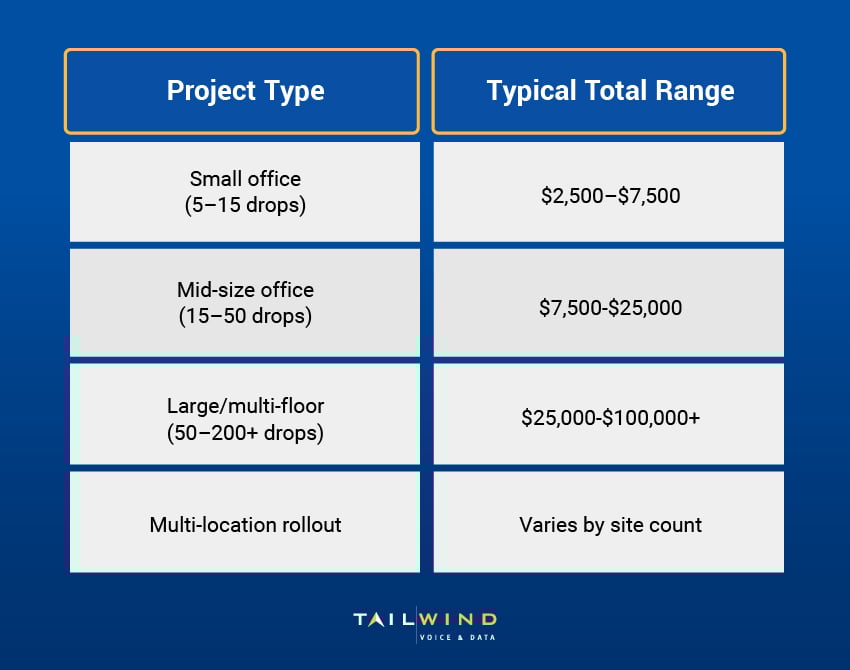
These ranges reflect commercial installations – not residential. Residential Ethernet projects are typically smaller and simpler, which is why the figures you'll see from home improvement sites tend to look lower. Enterprise deployments involve longer cable runs, more complex pathways, patch panels, rack integration, and documentation requirements that add real cost.
What Factors Drive Ethernet Installation Cost
No two Ethernet deployments are priced the same. Here are the factors that actually drive installation project cost:
1. Cable Category
The cable type you specify has a direct impact on both material cost and future capability.
- Cat5e: Supports up to 1 Gbps. Lower material cost but limited headroom. Not recommended for new commercial installs.
- Cat6: Supports 1 Gbps reliably and 10 Gbps at shorter distances. This is the current commercial standard for most office and retail environments.
- Cat6A: Supports 10 Gbps at full 100-meter runs. These larger diameter cables come at a slightly higher cost, and they’re usually recommended for data centers, high-density deployments, and infrastructure you expect to use for 10+ years.
- Fiber: For backbone runs between floors or buildings, fiber is often the right call. It comes at a higher material cost but with significantly lower signal loss over long distances.
Cat5e is the minimum for gigabit Ethernet, but most commercial installations today spec Cat6 or Cat6A.
2. Building Construction & Pathway Complexity
This is one of the biggest cost variables and one that's easy to underestimate. For instance, running cable through a drop ceiling in a newer commercial building is straightforward. Running cable through a concrete-and-steel structure, a historic building with no existing conduit, or a facility that requires in-wall fishing adds significant labor cost.
Conduit installation, which is required in many commercial and industrial settings, also adds material and labor expense.
3. Number Of Drops & Run Lengths
Per-drop cost generally decreases as the number of drops increases, due to labor efficiency – a crew mobilized for a 200-drop project will move faster per drop than one executing a 10-drop job.
Run length matters too: a 30-foot pull to a nearby wall jack is less labor-intensive than a 200-foot run through multiple walls and above a suspended ceiling.
4. Patch Panels, Racks & Termination
Professional Ethernet installation isn't just cable and wall jacks. It includes terminating every run at a patch panel in a structured cabling enclosure, labeling every port, and testing each run end-to-end.
For larger deployments, this means full rack infrastructure – patch panels, cable management, horizontal and vertical managers, and potentially a dedicated IDF (intermediate distribution frame) on each floor.
5. Testing & Certification
Post-installation testing is not optional for enterprise Ethernet. Every run should be tested with a certified tester (like a Fluke DSX or similar) to verify that the cable meets the performance specification it was installed to.
This adds cost but is what separates a certified installation that carries a warranty from a best-effort guess. TailWind includes comprehensive end-to-end testing and certification with documented results as a standard deliverable on all installations, ensuring your infrastructure meets its specifications and performs as designed.
How Much Is Ethernet As A Managed Service vs Outright Installation
For many businesses, the question isn't just how much Ethernet costs to install – it's how to budget for it. There are two primary models:
Capital Expenditure (CapEx) Installation
Traditional Ethernet installation is a one-time capital expense. You pay for design, materials, labor, testing, and documentation. You own the infrastructure, and it typically carries a warranty of 15–25 years when properly installed to manufacturer specifications. For most multi-location enterprises running a planned buildout or refresh, this is the standard approach.
Carrier-Delivered Business Ethernet
There's a separate but related question when it comes to WAN connectivity: how much does Ethernet cost per month as a carrier service? Business Ethernet from a carrier – connecting your locations to each other or to the internet with dedicated Ethernet circuits – is priced differently from in-building cabling.
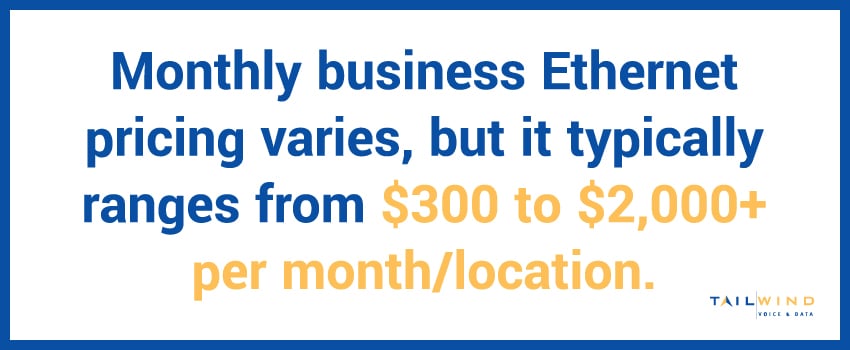
Monthly business Ethernet pricing ranges from $300 to $2,000+ per month per location, depending on bandwidth needs, service tier, and geography. This is a recurring operational cost, not a one-time installation spend, and it's managed through your carrier relationship.
For businesses managing connectivity costs across multiple sites, our Telecom Expense Management (TEM) services and Telecom Audits can surface billing errors and identify opportunities to consolidate or renegotiate carrier contracts – often recovering significant spend.
Business Ethernet Pricing For Multi-Location Enterprises
Multi-location businesses face unique installation cost considerations that single-site projects don't. When you're deploying Ethernet infrastructure across dozens or hundreds of locations, you have to factor in:
- Volume Pricing: Higher drop counts and multi-site scope usually unlock lower per-drop rates from contractors with national reach.
- Standardization Value: Standardizing cable category, rack configuration, and labeling conventions across all sites reduces per-site design time and simplifies ongoing support.
- Scheduling Complexity: Coordinating installations across multiple locations, each with different business hours, building access requirements, and local conditions, adds project management overhead that needs to be scoped and priced accordingly.
- Documentation and Handoff: Enterprise deployments should deliver as-built drawings, cable schedules, and certified test results for every site, not just a completed installation.
TailWind’s nationwide rollout capabilities are built around exactly these challenges. We coordinate installation across multi-location deployments – managing technician scheduling, material procurement, quality control, and documentation – so you get a consistent, certified result at every site without having to manage a separate contractor relationship in every city.
What's Included In An Ethernet Cable Installation Cost Quote?
Before signing any Ethernet installation contract, you should understand what's included in the scope and what might be extra. Here's what a commercial quote should include:
- Cable materials (Cat6, Cat6A, or fiber as specified)
- Wall jacks and faceplates at each endpoint
- Patch panel termination and labeling
- Rack or enclosure hardware, if not already in place
- Cable management (horizontal and vertical managers, velcro, etc.)
- Testing and certification with documented results
- As-built documentation
Items that are typically excluded and can add more cost if not scoped upfront:
- Conduit installation, especially in industrial or exposed environments
- Core drilling or fire-stopping penetrations through rated walls or floors
- Network switch or active equipment procurement and configuration
- Demarc extension from the carrier's entry point to your equipment room
If your project includes the last item, our Demarc Extension services handle that piece – bridging the gap between where the carrier hands off and where your equipment lives.
How To Get An Accurate Ethernet Installation Cost Estimate
One of the most common reasons Ethernet projects come in over budget is an incomplete scope at the start. Here's what you can do to get a more accurate estimate upfront:
Document Your Floor Plan
Know the square footage, number of floors, and approximate cable run lengths for each of your locations before engaging vendors.
Define Your Endpoint Count
Each workstation, IP phone, access point, camera, and printer that needs a wired connection is a drop. Count them before you ask for pricing.

Specify The Cable Category
Don't leave this open-ended. If you don't have a preference, ask your installer to recommend based on your performance requirements and budget. TailWind's certified engineers can help you evaluate your needs and recommend the right cable category for your performance requirements and timeline.
Ask About Building Conditions
Existing conduit, ceiling type, wall construction, and fire-rated penetration requirements all affect labor cost and should be discussed before a quote is finalized.
Request A Certified Installation
Make sure test results and documentation are part of the deliverables. If they're not offered, that's a red flag.
Ready To Get An Ethernet Installation Quote For Your Business?
Ethernet installation cost varies widely – but for enterprise businesses, the investment in properly designed and certified infrastructure pays off in network performance, reliability, and longevity. Getting it right the first time is almost always less expensive than fixing a poorly installed system later.
At TailWind, we manage all aspects of your network cabling installation project, from design through completion. Our certified engineers work with you to connect your sites, optimize performance, and ensure your network infrastructure is future-proof. We're your partner from installation through completion, providing complete accountability and responsive on-site service from more than 3,000 dispatch points across the U.S. and Canada.
Whether you're planning a single-site buildout or a coordinated deployment across dozens of locations, our team is ready to help you scope the project, deliver a detailed quote, and execute to a certified standard. Reach out today to get started!
Sources: