Pull open the jacket of almost any Ethernet cable, and you'll find the same thing: pairs of copper conductors twisted around each other in a tight, consistent helix. That twist isn't incidental – it's the core engineering principle behind modern commercial network cabling.
Read on to learn what twisted pair wire is, how the different types compare, and where each is used, so you can make better infrastructure decisions when specifying or evaluating a cabling project.
TL;DR
-
A twisted pair cable sends data over two insulated copper conductors twisted together, and that twist cancels electromagnetic interference so the signal stays clean across the run.
-
Unshielded twisted pair (UTP) is the default for most commercial installs, while shielded (STP) is reserved for high-interference areas near motors, heavy equipment, or dense Cat6A runs.
-
Cat6 is the minimum spec for new commercial cabling, and Cat6A is recommended for 10G networks, with fiber the better answer once a run needs more than 10G.
-
Twisted pair Ethernet cable is the backbone of enterprise networks, carrying structured cabling drops, Power over Ethernet, VoIP phones, and building automation systems.
What Is A Twisted Pair Cable?
A twisted pair cable is made up of two insulated copper conductors twisted together along their length. The twisting cancels electromagnetic interference (EMI) through differential signaling: the two conductors carry opposite versions of the same signal, so any interference that hits both conductors equally gets canceled out when the signal is read. The tighter the twist rate, the better the noise rejection.
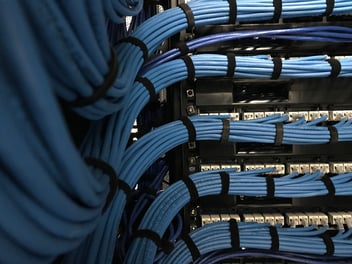
Every Cat5e, Cat6, and Cat6A Ethernet cable in a commercial installation is a twisted pair cable – eight conductors arranged in four twisted pairs inside a single jacket.
Twisted Pair Cable Types: UTP, STP & FTP
Twisted pair cables break into subtypes based on whether and how they include additional shielding beyond the twist itself.

The three main constructions are UTP, STP, and FTP:
Unshielded Twisted Pair (UTP)
UTP is the default spec for most structured cabling projects, and the most widely used twisted pair wiring in commercial Ethernet installations. It relies on the twist to reject interference, making it lighter, more flexible, and less expensive than shielded variants.
Shielded Twisted Pair Cable
Shielded twisted pair cable (STP) adds a metallic shield for additional EMI protection, which is important wherever cables run near motors, heavy equipment, MRI machines, or other interference sources.
Common shielding notations under ISO/IEC 11801 include:
- F/UTP: Overall foil shield, which is common in Cat6A for alien crosstalk reduction.
- U/FTP: Individual foil-shielded pairs, which are good for high-frequency applications.
- SF/FTP: Braided overall plus individual pair foil, which provides maximum shielding for high-EMI environments.
Shielded cable requires proper grounding to function correctly; an improperly grounded installation can actually perform worse than an unshielded cable.
Twisted Pair Shielded Cable vs UTP: How To Choose
UTP is typically the correct spec for most commercial office, retail, and hospitality deployments, as it’s easier to install and manage. When cables run through high-EMI areas, Cat6A is deployed in dense environments where alien crosstalk is a concern, or the environment requires it, shielded twisted pair cable is the right choice.
Twisted Pair Ethernet Cable: Category Standards & Performance
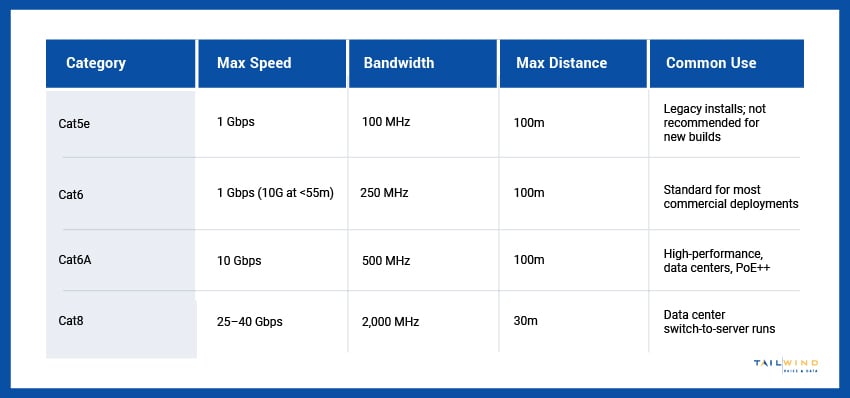
Cat6 is the standard minimum for new commercial installations in 2026, while Cat6A is the recommended specification for any infrastructure expected to support 10G networking, high-density PoE, or long service life.
Higher categories exist above Cat6A, though they see limited use in commercial building cabling. Cat8 is a recognized TIA standard that supports 40 Gbps, but only over short runs of up to about 30 meters, which is why it lives almost entirely in the data center for top-of-rack and switch-to-switch links rather than horizontal drops to the desk.
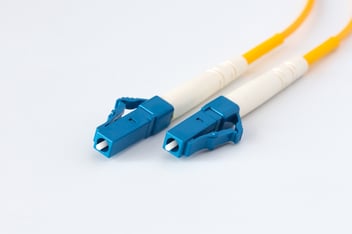
Cat7 and Cat7A were defined under ISO/IEC rather than TIA and never became a recognized category for structured cabling in North America, so they are rarely specified on commercial projects here. For the vast majority of office, retail, medical, and multi-site deployments, the practical decision still sits between Cat6 and Cat6A. If a run needs more than 10G at the edge, the answer is usually fiber, not a higher copper category.
Not sure which category is right for your needs? At TailWind, our structured cabling team specifies and installs twisted pair Ethernet cable to TIA-568 standards on every project, with certified test results for every run.
Connectors & Termination For Twisted Pair Cable
Twisted pair Ethernet cable is terminated with an RJ-45 connector (technically an 8P8C modular connector), wired to one of two standard pinouts: T568A or T568B. The pinout defines which conductor lands on which pin, and every run on a project should use the same one end to end to avoid crossed pairs.
In a structured cabling install, that termination happens at a few defined points:
-
RJ-45 plugs: Crimped onto patch cords and equipment cords, the short cables that connect a device or a switch port to the fixed cabling.
-
Keystone jacks: Conductors are punched down into a jack at the wall plate, giving each drop a clean modular outlet.
-
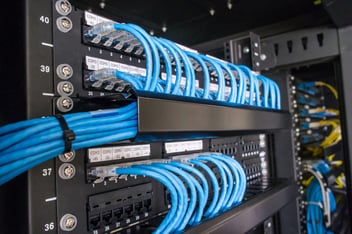
Patch panels: At the rack end of the run, each cable is punched down onto a patch panel port, so moves, adds, and changes happen with a patch cord instead of a new cable pull.
Termination quality determines whether a cable performs to its rated category. An untwisted pair length that runs too long at the connector, a loose punch-down, or a mismatched pinout can drop a certified Cat6A run below spec even when the cable itself is compliant. This is why TIA-568 testing certifies the finished link, connectors included, not just the cable on the reel.
Coaxial Cable vs Twisted Pair: Which Is Right For Your Application?
Twisted pair and coaxial cable are both widely used in commercial IT and telecom infrastructure, but for different applications. Here's how they compare:
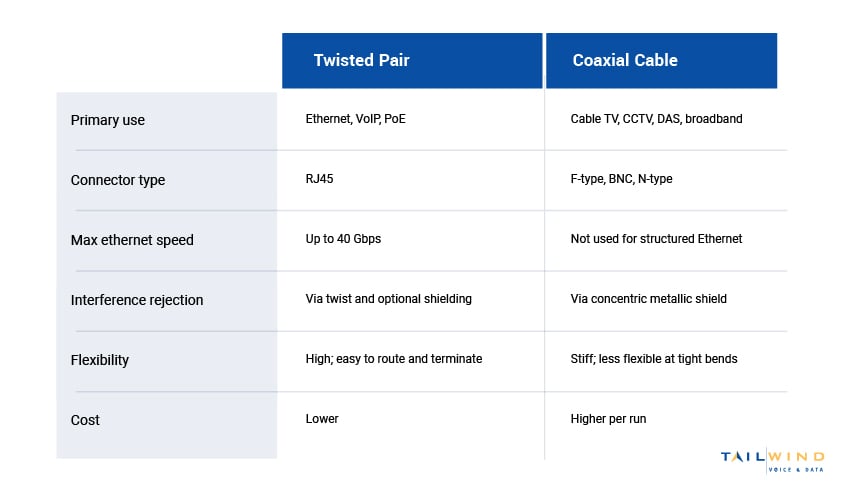
In short, twisted pair Ethernet cable is usually the go-to choice for network drops, VoIP phones, access points, and PoE devices, and coaxial cable is better for broadband distribution, security cameras, and in-building antenna infrastructure. Most commercial deployments use both – each in the applications it's designed for.
What Twisted Cables Are Used For In Commercial Deployments
The versatility of twisted pair wiring makes it the dominant cable type in commercial IT infrastructure. Its applications include:
- Structured Cabling (Horizontal Runs): Every workstation drop, IP phone, access point, and wired endpoint in a commercial building is served by a twisted pair Ethernet cable run from the patch panel to the wall jack.
- PoE (Power over Ethernet): IP cameras, access control readers, wireless access points, and desk phones all receive both data and power over twisted pair Ethernet – eliminating the need for a separate power outlet at each device.
- VoIP Telephony: IP desk phones connect via twisted pair Ethernet to the network switch and PBX, with PoE powering the handset through the same cable.
- Building Automation and IoT: Smart building systems like HVAC controls, lighting automation, and sensors use twisted pair Ethernet for both communication and power delivery.
If you’re deploying or upgrading network infrastructure across multiple locations, getting the twisted pair spec right – category, shielding type, and installation standard – is essential for every device connected to your network.
TailWind’s field services team manages twisted pair cabling deployments across commercial environments of every type, with consistent standards and documented results at every site.

Twisted Pair Cable FAQs
What Is A Twisted Pair Cable?
A twisted pair cable carries data over two insulated copper conductors twisted around each other along their length. The twist is the whole point: it cancels electromagnetic interference so the signal stays clean. In commercial networks, twisted pair almost always means Ethernet cable, with eight conductors arranged as four twisted pairs inside a single jacket. Cat5e, Cat6, and Cat6A are all twisted pair cables. It is the dominant cabling type for workstation drops, VoIP phones, wireless access points, and other wired endpoints in a building.
What Is Unshielded Twisted Pair (UTP) Cable?
Unshielded twisted pair (UTP) is twisted pair cable that relies on the twist alone to reject interference, with no added metal shielding. It is the default specification for most structured cabling projects because it is lighter, more flexible, and less expensive than shielded cable, and it is easier to install and manage. UTP handles the large majority of commercial office, retail, and hospitality deployments. Shielded cable is reserved for high-interference environments or dense runs where alien crosstalk is a concern.
What Is The Difference Between UTP And STP Cable?
Both are twisted pair cables. The difference is shielding. UTP uses only the twist to reject interference, which keeps it light, flexible, and affordable. STP adds a metallic shield, foil or braid, around the pairs or the whole cable for extra protection near motors, heavy equipment, or other strong interference sources. STP performs better in electrically noisy spaces, but it costs more, is less flexible, and must be properly grounded to work. An improperly grounded shielded cable can perform worse than plain UTP.
What Is A Twisted Pair Cable Used For?
In commercial buildings, twisted pair Ethernet cable connects nearly every wired device to the network. Common uses include structured cabling horizontal runs from the patch panel to each wall jack, Power over Ethernet for IP cameras, access control readers, and wireless access points, VoIP desk phones, and building automation systems like HVAC controls, lighting, and sensors. Because a single twisted pair run can carry both data and power, it removes the need for a separate outlet at many of these devices.
Which Connector Is Used With Twisted Pair Cable?
Twisted pair Ethernet cable is terminated with an RJ-45 connector, technically an 8P8C modular connector, wired to either the T568A or T568B pinout. RJ-45 plugs are crimped onto patch cords and equipment cords, while the fixed cabling is punched down into keystone jacks at the wall plate and onto a patch panel in the rack. The whole run should use one consistent pinout end to end. Poor termination can drop even a compliant Cat6A cable below its rated performance.
How Does A Twisted Pair Cable Work?
Each pair of a twisted pair cable carries a signal across two copper conductors that hold opposite versions of that signal. The receiver reads the difference between the two, a method called differential signaling. Twisting the conductors keeps electrical performance consistent along the cable and lets any outside interference hit both wires equally, so it cancels when the signal is read. Tighter twist rates give better noise rejection. Grouped as four pairs and terminated with RJ-45, this is what carries Ethernet traffic through a building.
How Does A Twisted Pair Cable Reduce Interference?
The reduction comes from the twist combined with differential signaling. The two conductors in a pair carry the same signal in opposite polarity, so any electromagnetic noise that lands on both equally is canceled out when the receiver reads the difference. Twisting the pair makes sure external interference reaches both conductors in the same amount along the whole length. The tighter the twist rate, the better the rejection. Neighboring pairs are twisted at different rates to limit crosstalk between them inside the jacket.
Can Twisted Pair Cable Carry Power over Ethernet (PoE)?
Yes. Twisted pair Ethernet cable carries both data and electrical power on the same cable through Power over Ethernet. This is how IP cameras, wireless access points, access control readers, and VoIP desk phones get powered without a separate outlet at each device. PoE relies on adequate cable, so Cat5e or higher is used, and higher-power PoE and dense deployments are a reason many projects specify Cat6A. The switch or a midspan injector supplies the power over the existing pairs.
What Is The Maximum Length Of A Twisted Pair Ethernet Run?
The standard limit for a twisted pair Ethernet channel is 100 meters, about 328 feet. That budget is normally split into a 90 meter permanent horizontal run from the patch panel to the wall jack, plus up to 10 meters of patch cords at the ends. Beyond 100 meters, signal loss and timing problems start to degrade the link, so longer distances call for fiber or an intermediate switch or extender. This limit applies across Cat5e, Cat6, and Cat6A for standard gigabit and 10G use.
What Is The Difference Between Solid And Stranded Twisted Pair Cable?
The difference is in the copper conductor. Solid cable uses a single solid copper wire per conductor, which gives better performance over distance and is the right choice for permanent runs inside walls, ceilings, and conduit. Stranded cable uses several thin copper strands per conductor, which makes it more flexible and better able to survive repeated bending, so it is used for patch cords and equipment cords at the ends of a link. A typical install uses solid for the horizontal run and stranded for the patch cords.
Ready To Build The Cabling Infrastructure Your Network Demands?
Twisted pair cable is the foundation of virtually every commercial network – and the quality of that foundation determines how reliably everything above it performs. Whether you're specifying a new buildout, upgrading aging Cat5e infrastructure, or standardizing cabling across multiple locations, getting the specification and installation right the first time is always less expensive than fixing it later.
At TailWind, we design and install structured cabling that meets your performance requirements and scales with your growth. We’ll handle all aspects of network and telecommunications cabling installation projects, from design and specification through installation, certification, and testing documentation.
Ready to get started? Get in touch with our cabling experts today, and let's build a network foundation you can depend on.