Buried beneath streets, running along highway corridors, and threaded through commercial buildings across the country is a substantial amount of fiber optic cable that isn't being used yet. This unused capacity is called dark fiber, and it represents one of the more specialized, high-value connectivity options available to enterprises that have the scale and technical requirements to take advantage of it.
Read on to learn what dark fiber is, how it compares to standard lit fiber services, and when it makes sense for your business.
What Is Dark Fiber? Definition and Meaning
Dark fiber refers to unused optical fiber cable – strands of fiber that have been installed but are not yet carrying a light signal or actively transmitting data. The term comes from the fact that, without a light source running through it, the fiber is literally "dark."
The dark fiber meaning is easier to grasp when you understand how fiber networks are built. Carriers often lay more fiber strands than they need for current demand, because the cost of trenching and installing conduit is higher than the cost of the fiber strands themselves. Instead of running one or two strands to a location, it's more economical to lay a bundle of 24, 48, or even 144 strands – using what's needed and leaving the rest dark.
How Does a Dark Fiber Network Work?
A dark fiber network is fundamentally different from a typical internet or WAN service in one key respect: the customer, not the carrier, controls what runs on it. When a business leases dark fiber, they are leasing the physical glass strand itself – not a managed data service.

This means the customer is responsible for supplying their own optical transmission equipment: the lasers, transceivers, and networking hardware that actually put a signal on the fiber. The customer determines the protocol, the bandwidth, and the wavelength – with complete control over how the connection performs, scales, and is configured.
Since there's no shared infrastructure or carrier-imposed bandwidth cap, and no intermediate equipment translating or managing the signal, dark fiber delivers the lowest possible latency and the highest possible bandwidth ceiling of any fiber connectivity option.
Dark Fiber Pricing: What To Expect
Dark fiber pricing is structured differently from standard lit services, typically as a flat lease rate per strand per mile for a set term rather than a per-Mbps rate. Actual pricing depends heavily on:
- Fiber Lease: Priced by route and term, most often through a multi-year operating lease or a long-term IRU. Operating leases run from about $1,000 to $5,000 per month for a short metro route, and $5,000 to $25,000 or more per month for long-haul routes.¹
- Optical Equipment: Equipment must be purchased separately from the lease, and it can be a big upfront capital investment. A basic 10 Gbps metro pair runs about $5,000 to $15,000 in transceivers, while a full two-endpoint DWDM build may reach $100,000 to $500,000.¹
- Construction and Last-Mile: Reaching a building not already on the fiber route can add substantial one-time cost and lead time, especially in areas without existing infrastructure.
Because pricing and availability vary so much by specific route and market, most dark fiber pricing requires direct quotes rather than published rate cards.
Dark Fiber vs. Lit Fiber: Key Differences
The dark fiber vs. lit fiber comparison is the starting point for understanding when each makes sense:
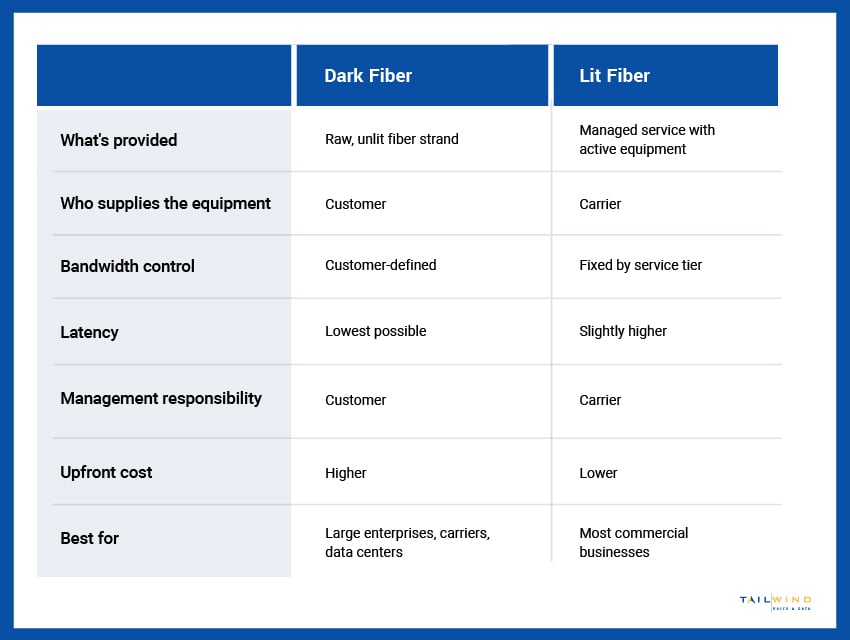
Lit fiber is what most businesses use: the carrier lights the fiber, manages the electronics, and delivers a defined service – internet access, metro Ethernet, or a private line – at a specified bandwidth. Dark fiber, by contrast, is infrastructure. The business buys the pipe and builds what runs through it.
What Are Common Use Cases for Dark Fiber Internet and Services?
Dark fiber services aren't the right fit for every business, but for organizations with the right requirements, the use cases are compelling:
Data Center Interconnection
Enterprises operating multiple data centers or colocation facilities use dark fiber to connect them directly, at whatever bandwidth their own equipment supports – without being capped by a carrier's service tiers. This is one of the most common dark fiber applications for large enterprises and cloud providers.
Disaster Recovery and Business Continuity
Organizations replicating data between a primary site and a disaster recovery site benefit from dark fiber's low latency and high, scalable bandwidth – critical for synchronous replication where every millisecond of delay matters.
Carrier and Wholesale Networking
Telecommunications carriers themselves lease dark fiber from infrastructure owners to build out their own networks, rather than constructing new fiber routes from scratch. This is a foundational use case in the wholesale telecom market.
Large Enterprise Private Networks
Organizations with extreme bandwidth needs across specific routes – campus-to-campus, building-to-building – sometimes find that leasing dark fiber and running their own equipment is more cost-effective long-term than paying for an equivalent lit service.
5 Benefits of a Dark Fiber Network for Business
With dark fiber, you own the active layer, and the carrier owns only the glass. That control translates into real operational value for organizations equipped to use it, including:
1. Bandwidth Scalability
Dark fiber bandwidth is limited only by the optical equipment you install – not your carrier's service tier. If you need to upgrade capacity, you often only have to upgrade equipment, not renegotiate a contract.
2. Lowest Possible Latency
With no carrier-managed equipment in the path, dark fiber delivers the most direct, minimally processed fiber connection available.
3. Complete Control
Using dark fiber lets your business control protocol, encryption, wavelength usage, and equipment – critical for organizations with specific security or performance requirements.
4. Long-Term Cost Efficiency
At very high, sustained bandwidth needs, the economics of owning the transmission equipment on a leased strand can beat recurring lit-service pricing over a multi-year term.
5. Multiple Wavelengths
Fiber providers use DWDM (Dense Wavelength Division Multiplexing) equipment, which enables a business to run many separate high-bandwidth circuits over a single dark fiber pair.
How To Find the Right Dark Fiber Providers
Dark fiber providers range from national carriers with extensive backbone networks to regional infrastructure companies with dense metro fiber footprints. The most important factors to consider when choosing a provider are:
- Route Availability: Not every provider has fiber on every route. Availability is often the deciding factor before price ever enters the conversation.
- Fiber Quality and Age: Older fiber may have higher attenuation or fewer available strands. Request documentation on fiber type and condition before committing.
- Contract Terms and IRU Structure: Determine whether you're leasing month-to-month or entering a long-term IRU (Indefeasible Right of Use), which operates more like ownership for the duration of the contract.
For most enterprises, dark fiber is just one of several options for high-capacity connectivity – and it's not always the right one.
TailWind’s carrier services team helps businesses evaluate dark fiber alongside metro Ethernet, DIA, and other high-bandwidth options to find the right fit for the actual requirement – not just the most technically impressive one.
Is a Dark Fiber Network the Right Choice for Your Business?
Dark fiber makes sense when your bandwidth requirements are extreme, sustained, and predictable enough to justify the equipment investment – and when you have the technical staff to manage the optical layer yourself.
A well-designed fiber service, whether it’s metro Ethernet, DIA, or a leased line, delivers the performance most enterprises need without the overhead of managing your own optical equipment.
TailWind’s broadband aggregation services help multi-location enterprises source the right connectivity mix – including dark fiber where it truly fits – across every site, managed under one relationship.
Evaluating Dark Fiber for Your Connectivity Strategy?
Dark fiber offers a level of control and scalability that few connectivity options can match, but it's a serious infrastructure commitment – not a simple service order. Understanding whether your business truly needs it, or whether a managed lit fiber service delivers the same outcome with less operational burden, is the first step.
If you're evaluating dark fiber, metro Ethernet, or another high-capacity option, the TailWind team is ready to help. As a single point of contact across more than 40,000 enterprise locations, we back every engagement with boots-on-the-ground support and nationwide field services, so the connectivity you choose gets sourced, installed, and managed consistently at every site.
Get in touch to get started – and let's find the right connectivity strategy for your business.
Sources: