Businesses rely on always-on network performance, but a 2025 survey found that 79% of organizations faced at least 10% more outages over the past two years.1 And outages don’t just frustrate your staff – when networks go down, customer trust (and your bottom line) suffers.
That’s where an NOC team comes in. Whether you’re a growing enterprise managing multi-site operations or a service provider supporting customers around the clock, your NOC technicians are the frontline defenders of network uptime.
But what exactly does a NOC technician do, and how does their work contribute to business continuity? Let’s explore the key roles within a Network Operations Center, from daily responsibilities to required skills and technologies.
What Is a NOC Technician?
A NOC technician – short for Network Operations Center technician – monitors and manages the health of a business’s network infrastructure. They’re responsible for identifying issues and responding to events that could impact your network’s performance, security, or availability.
The role goes by several different titles depending on the organization and seniority level:
- Network operations technician
- NOC operator
- NOC analyst
- NOC specialist
- NOC engineer
Regardless of what they’re called, their core goal remains the same: to ensure the network is performing as expected.
At TailWind, our NOC team plays a vital role in supporting customers across all our managed network services. From small businesses to nationwide enterprises, we deliver 24/7 NOCaaS (NOC as a Service) support that scales with your environment.
What Does a NOC Technician Do?
Every network environment is different, so a NOC team’s day-to-day duties vary. Some of their most common responsibilities are:
Real-Time Network Monitoring
NOC technicians continuously monitor network devices, connections, and services using specialized tools and dashboards. Their goal is to spot performance issues, security threats, or anomalies before they disrupt business operations.
Common tools include:
- SNMP-based monitoring systems
- Flow analysis (NetFlow, sFlow)
- Performance and availability alerting platforms
TailWind’s NOC experts use network monitoring tools that allow us to detect potential problems before they impact end users – ensuring proactive response and minimal downtime.
Incident Response and Ticketing
NOC engineers take action whenever an alert is triggered or service degradation is detected. They assess the issue, create a ticket, and begin triage or escalation depending on severity and service level agreements.
NOC support teams coordinate directly with field technicians, ISPs, and internal IT teams to resolve incidents efficiently. This coordination keeps business-critical systems online and minimizes the window during which customers experience disruption.
Configuration and Change Management
While troubleshooting is a big part of the job, many NOC specialists also assist with device configurations, updates, and patch management.
For example, they may:
- Apply firmware updates to routers or firewalls
- Push configuration changes to remote sites
- Verify backups of key device configurations
NOC teams typically follow strict change control processes to minimize risk, especially in multi-location environments where making changes in one area can affect many others.
Reporting and Documentation
NOC technicians document every action they take for auditing, compliance, and root cause analysis. This includes logging incidents and resolutions, documenting device changes, and providing shift hand-off reports.
At TailWind, we analyze the insights from reports to prevent future issues from occurring through pattern recognition and long-term planning.
NOC Support vs. Other IT Roles
It’s common to confuse a NOC technician with other IT roles – especially help desk or field support positions. While there is some overlap, NOC roles are primarily focused on infrastructure health and proactive response, rather than direct end-user support.
Here's how it compares:
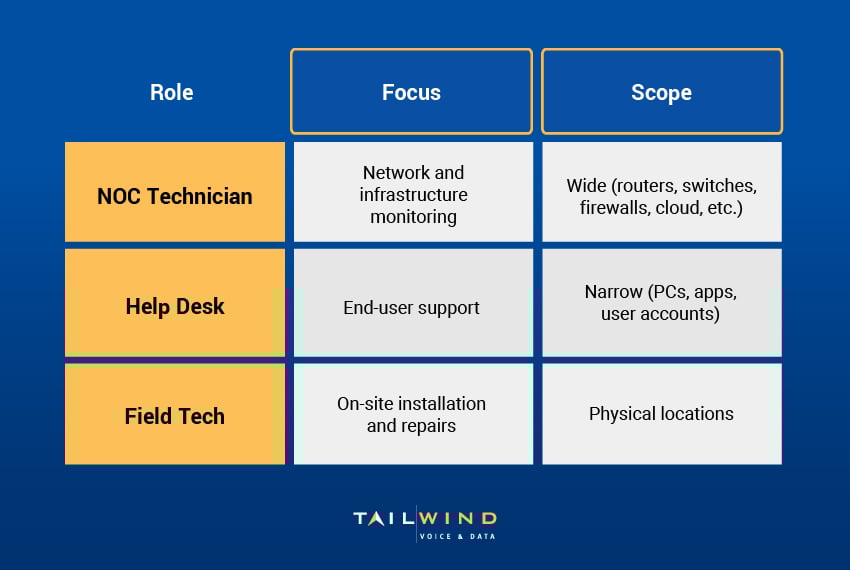
At TailWind, we combine all three through our nationwide footprint and managed services portfolio. Our NOCaaS, field services, and centralized support team work together to deliver seamless IT operations for multi-site businesses.
4 Skills Every NOC Technician Needs
Working in a NOC isn’t just about knowing how to reboot a switch. Here are the key competencies required for NOC support roles:
1. Technical Knowledge
Of course, the most important skill for an NOC professional is a strong knowledge of networking. They should understand:
- OSI model
- TCP/IP and subnetting
- Routing and switching protocols
- Firewalls and security appliances
- VPNs and wireless technologies
NOC teams handle diverse network environments, so the most effective technicians prioritize ongoing training to stay current with evolving technologies and threats.
2. Problem Solving
NOC work is often high-pressure and time-sensitive. When a critical service goes down, customers are already losing money and trust in your organization. Technicians need to think critically and respond calmly, even when an outage affects thousands of users.
3. Communication
Since they often work alongside engineers, vendors, and customer teams, NOC staff must be able to communicate clearly, both verbally and in writing. For example, a technician might need to explain a complex issue to a non-technical customer or provide detailed information to a senior engineer.
4. Tool Proficiency
A NOC operator should be comfortable using several categories of tools, such as:
- Network monitoring platforms (e.g., PRTG, SolarWinds, Nagios)
- Remote access and troubleshooting tools
- Ticketing and ITSM platforms
- Dashboards and reporting tools
TailWind’s team leverages a combination of in-house and third-party tools to deliver fast, consistent service for every customer.
What Is an NOC Team?
An NOC team is made up of multiple professionals working in shifts to provide 24/7 coverage. Common roles include:
- Tier 1 NOC Technician: Tier 1 technicians provide entry-level monitoring and basic issue resolution, and escalate complex problems to more senior NOC staff.
- Tier 2/3 NOC Engineer: Tier 2/3 techs handle advanced troubleshooting, configuration, and escalations.
- NOC Analyst: These team members identify patterns that help prevent future incidents and track metrics against SLA targets.
- NOC Manager: The manager oversees the team, SLAs, and coordination with other departments.
While some businesses maintain their own NOC, others find it more cost-effective to outsource this function to a provider like TailWind that offers fully managed NOC services. Outsourcing provides access to expertise and around-the-clock coverage without the overhead of hiring and training a large in-house team.

Get Started With Managed NOC Support From TailWind
With per-outage losses ranging from $10,000 to over $1,000,000,2 the stakes of NOC work have never been higher.
TailWind’s NOCaaS offering delivers the expertise and infrastructure your business needs to reduce downtime, improve network visibility, or offload day-to-day monitoring. Our NOC specialists, engineers, and technicians work behind the scenes – so your business stays ahead of network issues before they happen.
Want to learn more about how we support your operations with 24/7 NOC services? Get in touch today to talk about your network goals.
Sources: