TL;DR
-
The core of EDR vs XDR is scope: EDR detects and responds to threats on endpoint devices like laptops and servers, while XDR extends that same protection across email, identity, cloud, and network data.
-
XDR is not a replacement for EDR but an evolution built on top of it, so many organizations start with EDR and adopt XDR as their environment grows more complex.
-
Managed detection and response (MDR) is a third option that delivers EDR or XDR as a managed service, fitting organizations that lack the in-house team to monitor and respond around the clock.
Endpoint security is no longer optional for any business, especially with the annual average cost of cybercrime expected to pass $23 trillion by 2027.1 Attackers constantly target the devices teams use every day, from laptops to servers to mobile phones.
If you're researching how to protect your organization, you’ve probably come across two acronyms that sound alike but do very different things: EDR and XDR. But what is EDR, and how does it compare to extended detection and response, or XDR? Read on to explore EDR meaning, how XDR extends its capabilities, and tips to help you decide which approach makes the most sense for your business.
What Is EDR In Cyber Security?
Endpoint detection and response (EDR) is an increasingly popular security option – analysts expect the EDR market to reach $6 billion this year, up from $5 billion in 2025.2
EDR tools focus specifically on monitoring and protecting endpoint devices like desktops, laptops, and servers from threats like malware, ransomware, and advanced attacks.
At TailWind, we recommend EDR to businesses that need clear visibility into what's happening on their endpoints, particularly if they have multiple locations or distributed teams.

EDR Meaning & Functions
EDR typically provides:
- Real-time threat detection on endpoints
- Behavioral analysis to flag anomalies
- Incident response workflows for isolating compromised systems
- Data forensics to investigate breaches
Unlike traditional antivirus tools, EDR doesn’t just block known threats – it continuously monitors endpoint activity for suspicious behavior.
What Does EDR Stand For In Practice?
While EDR stands for “Endpoint Detection and Response,” the real meaning lies in how it’s implemented. You’re not just deploying software – you’re equipping your team with a system that can:
Automate Threat Detection
Rather than requiring your security team to manually review every suspicious activity, EDR automates initial threat detection and prioritization. The system analyzes millions of endpoint events, categorizes them by severity, and surfaces only the alerts that genuinely warrant human attention.
Free Up Internal IT Staff
Security operations can be resource-intensive. EDR reduces the workload on your team by automating repetitive monitoring tasks, allowing them to focus on more strategic tech initiatives rather than spending all their time watching for threats.
For distributed organizations, this frees up teams at different locations to handle local business needs while the EDR system provides consistent security oversight.
Reduce Dwell Time
Attackers spend time inside your network before you discover them. EDR drastically reduces this "dwell time" by detecting suspicious behavior in real time and enabling immediate response. When an endpoint shows signs of compromise, EDR can isolate that device automatically, preventing lateral movement to other systems.
Simplify Compliance Reporting
Many industries require detailed records of security monitoring and incident response activities. EDR provides comprehensive logs and forensic data that simplify audit preparation and compliance reporting.
Instead of scrambling to reconstruct what happened during an incident, you have detailed records already in place, making regulatory assessments faster and less resource-intensive.
What Is EDR Security Designed To Solve?
EDR security was developed to solve the limitations of signature-based tools and give IT teams better context around attacks.
Problems EDR helps solve include:
- Zero-day threats and unknown malware
- Lateral movement detection during a breach
- Rapid incident containment to minimize damage
- Fileless malware and in-memory attacks
- Post-breach investigation and root cause analysis
If a remote laptop connects to an insecure network and starts exhibiting suspicious activity, an EDR tool can flag it, isolate it from the network, and provide logs for investigation – all in real time.
At TailWind, we use EDR technology to give our customers peace of mind by proactively monitoring endpoints across their entire infrastructure.
What Is XDR In Cybersecurity?
If EDR focuses on the endpoint, XDR – Extended Detection and Response – takes a broader view.
XDR brings together data from multiple security layers, including:
- Endpoints (devices and servers)
- Email systems
- Network traffic
- Cloud workloads
- Identity and access systems
With this holistic approach, your teams see the complete attack sequence rather than isolated events on individual endpoints.
What EDR & XDR Have In Common: Key Similarities
EDR and XDR are often framed as rivals, but they share the same DNA. Both grew out of the same core idea: watch for suspicious behavior continuously, then act on it fast. Before you weigh the differences, it helps to know where the two overlap.
Both EDR and XDR share these fundamentals:
-
Continuous, real-time monitoring: Each one watches activity around the clock and flags anomalies as they happen, rather than after the damage is done.
-
Behavioral detection over signatures: Both look for suspicious behavior and patterns, not just known malware signatures, which lets them catch new and unknown threats.
-
Automated incident response: When something looks wrong, both can act on their own, from isolating a device to shutting down a malicious process.
-
AI and machine learning: Both lean on machine learning to sort real threats from noise and improve detection accuracy over time.
-
Threat hunting and forensics: Both give your team the data to investigate an incident and understand how it unfolded.
The most important thing they share is lineage. XDR is not a competitor that replaces EDR; it is built on top of it. Most XDR platforms use endpoint detection as their foundation, then extend that same logic across email, identity, cloud, and network data. Seen that way, the question is rarely EDR or XDR in the abstract. It is how far beyond the endpoint you need that detection-and-response approach to reach.
What’s The Difference Between EDR And XDR?
Let’s break down the key differences between XDR vs EDR, and what each is best suited for:
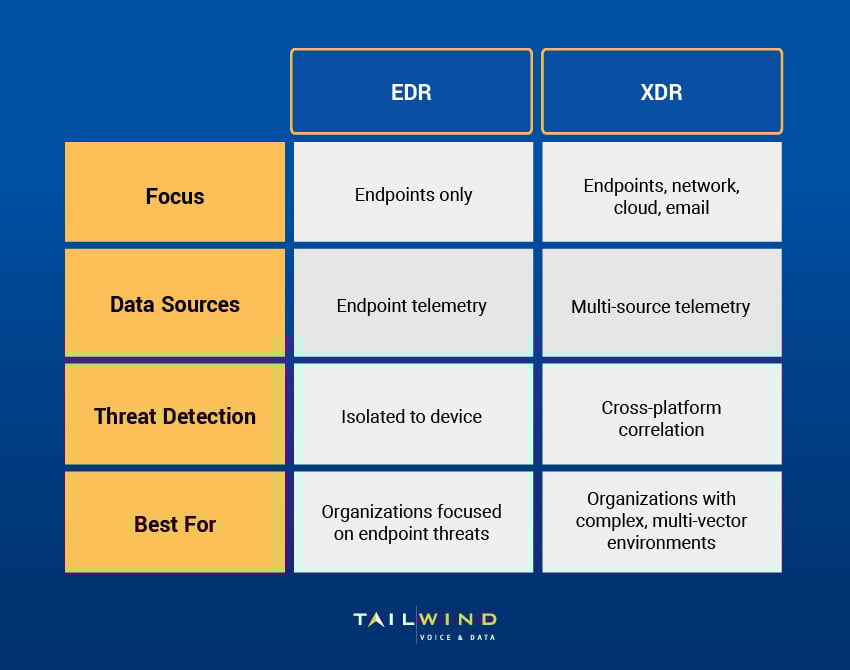
While EDR forms a foundational part of most XDR solutions, XDR extends the vision beyond the endpoint. It connects information across your entire IT ecosystem to provide a more complete picture of what's happening in your environment.
Use Case: EDR vs XDR For A Multi-Location Business
If you’re a retailer with 50 locations, EDR may help you secure each endpoint individually. But if you also use cloud apps, remote workers, and UCaaS platforms, XDR gives you visibility across the full attack surface.
That’s why at TailWind, we help clients assess their environment holistically. We guide them to the right solution – whether it’s EDR, XDR, or a hybrid approach.
EDR vs MDR vs XDR: Where Managed Detection Fits
So far the choice has been EDR or XDR, but there is a third acronym you will run into: MDR, or managed detection and response. It fits a different axis than the other two. EDR and XDR describe what a tool watches; MDR describes who runs it.
MDR is detection and response delivered as a managed service. Instead of buying an EDR or XDR platform and staffing a team to run it, you hand the day-to-day monitoring, threat hunting, and response to an outside team that does it for you, around the clock. In practice, MDR usually sits on top of an EDR or XDR tool rather than replacing either one.
That distinction is what makes MDR worth knowing about when you compare EDR and XDR:
-
EDR gives you deep visibility into endpoints, but someone on your team has to watch the alerts and act on them.
-
XDR widens that visibility across email, identity, cloud, and network, but it also asks more of the people managing it.
-
MDR answers the staffing question. It pairs the tooling with a team, which matters most if you lack in-house security expertise or the hours to cover nights and weekends.
For organizations with lean IT teams or locations spread across the map, the deciding factor often is not endpoint versus extended. It is whether you have the people to run detection and response at all. That is where a managed approach earns its place, and where a partner like TailWind can carry the monitoring load across every site.
How EDR & XDR Relate To SIEM, SOAR & NDR
EDR and XDR do not live in a vacuum. They sit alongside a handful of other security acronyms, and knowing how they connect makes the EDR-versus-XDR choice clearer. Here is where the main ones fit:
SIEM (Security Information & Event Management)
SIEM collects and analyzes log data from across your environment, from servers to firewalls to applications. It is strong at aggregation and compliance reporting, but on its own it detects less and responds less than EDR or XDR.
SOAR (Security Orchestration, Automation & Response)
SOAR automates and coordinates response workflows across your security tools. Where EDR and XDR detect and respond, SOAR is the layer that ties those actions together and runs them without manual steps.
NDR (Network Detection & Response)
NDR focuses on network traffic, watching for suspicious activity moving between systems. It covers a blind spot that endpoint-only tools miss.
XDR is what pulls many of these threads together. Rather than running endpoint, network, email, and identity monitoring as separate products with separate alerts, XDR correlates their signals into one view. SIEM and SOAR often still have a role, especially in larger security teams, but XDR reduces how many disconnected consoles your analysts have to juggle. For most organizations weighing EDR against XDR, the practical question is how many of these layers you are trying to cover, and how much of that you want stitched together for you.
What Is The Advantage Of XDR Over EDR?
The biggest advantage of XDR over EDR is correlation.
EDR might show you that an endpoint was infected. XDR shows you the full kill chain:
- The phishing email that delivered the malware
- The file that was downloaded to a local machine
- The lateral movement to cloud resources
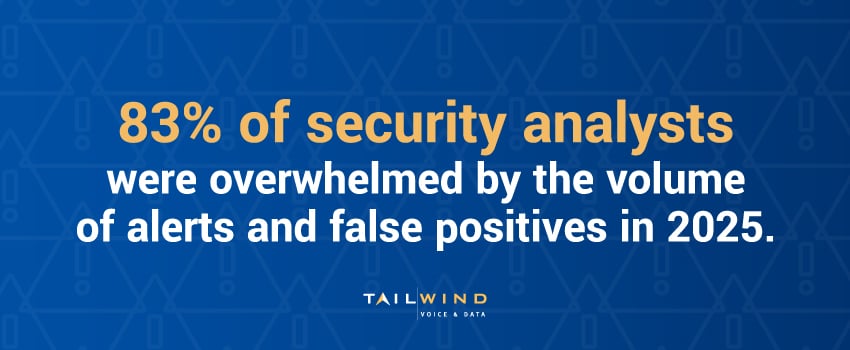
This end-to-end visibility empowers faster, smarter responses. It also helps overburdened IT teams avoid alert fatigue by reducing false positives – a must, considering 83% of security analysts reported feeling overwhelmed by the volume of alerts and false positives in a 2025 survey.3
Do You Need EDR, XDR, Or Both?
Still torn between EDR vs XDR? The right approach will depend on your organization’s:
- IT Maturity: Does your team have the expertise to manage advanced security tools?
- Environment Complexity: Are you protecting only endpoints, or do you also have cloud services, email, networks, and identity systems?
- Compliance Requirements: Do auditors or regulators require granular visibility into specific activities?
- Growth Plans: Do you have plans to expand or support more remote work?
For many organizations, starting with EDR makes sense. It delivers immediate improvements in threat detection with less deployment complexity and lower initial costs. But as your IT environment grows more complex, XDR is essential for getting the extended visibility and automation needed to keep up with modern threats.
One factor worth weighing alongside the rest is cost, and not just the sticker price. EDR generally carries a lower upfront cost and less deployment complexity, which is part of why it is a common starting point. XDR costs more to license and integrate, but it can lower your total cost of ownership over time by consolidating separate tools into one platform and cutting the hours your team spends chasing disconnected alerts.
Factor in staffing, too: running either tool well takes skilled people, and if that expertise is hard to hire or retain, a managed option can be the more cost-effective route than building the capability in-house. The right budget question is not which tool is cheapest today, but which gives you the coverage you need at a total cost your team can sustain.
XDR vs EDR FAQs
What Is The Difference Between EDR, MDR, And XDR?
EDR, MDR, and XDR solve related problems in different ways. EDR (endpoint detection and response) monitors and protects endpoint devices like laptops and servers. XDR (extended detection and response) widens that scope across email, identity, cloud, and network data, correlating signals into one view. MDR (managed detection and response) is not a tool at all: it is detection and response delivered as a managed service, usually running EDR or XDR on your behalf. Put simply, EDR and XDR describe what gets watched, while MDR describes who watches it.
Can XDR Fully Replace EDR, Or Should You Run Both?
XDR does not replace EDR so much as build on it. Most XDR platforms use endpoint detection as their foundation, then extend that same detect-and-respond logic across other layers like email, identity, and cloud. So in practice you are not choosing between the two; adopting XDR means you already have EDR-style endpoint coverage inside it. The real decision is whether you need protection to reach beyond the endpoint. If your risks are largely endpoint-based, EDR alone may be enough. If threats move across your environment, XDR gives you the wider view.
What Is The Difference Between EDR, XDR, And SIEM?
EDR and SIEM do different jobs. EDR (endpoint detection and response) actively detects and responds to threats on endpoint devices. SIEM (security information and event management) collects and analyzes log data from across your environment, which makes it strong for aggregation and compliance reporting but weaker on active response. XDR (extended detection and response) sits between them in spirit: it correlates detection-and-response data across endpoints, email, identity, cloud, and network into a single view. Many organizations run SIEM and XDR together, with SIEM handling broad log analysis and XDR driving faster detection and response.
What Is The Difference Between XDR, EDR, And SOAR?
SOAR plays a different role than EDR and XDR. EDR detects and responds to threats on endpoints, and XDR extends that across multiple layers. SOAR (security orchestration, automation, and response) does not detect threats on its own; it automates and coordinates the response steps that follow a detection, running them across your security tools without manual effort. Think of EDR and XDR as the sensors and responders, and SOAR as the conductor that orchestrates the response. In many modern security operations, XDR and SOAR capabilities are increasingly combined in one platform.
How Much Do EDR, MDR, And XDR Solutions Cost?
Cost depends on the option and how you buy it, so treat these as directional rather than fixed. EDR usually carries the lowest upfront price and the simplest deployment, which makes it a common starting point. XDR costs more to license and integrate, but it can reduce your total cost of ownership by consolidating tools and cutting the time your team spends on scattered alerts. MDR shifts spending toward a service fee instead of in-house staffing, which often pays off if security talent is hard to hire. The cheapest tool is not always the lowest total cost.
Is EDR Or XDR Better For A Lean Security Team?
For a lean security team, the honest answer often is neither on its own. EDR is simpler to deploy and lighter to run than XDR, so it is the more manageable starting point if your priority is endpoint protection. XDR delivers broader visibility but asks more of the people managing it, which can strain a small team. If you lack the hours or in-house expertise to watch alerts around the clock, a managed option (MDR) may serve you better than either tool alone, because it pairs the technology with a team that runs it for you.
Level Up Your Cybersecurity With TailWind
Both EDR and XDR play a critical role in protecting today’s complex IT environments. But choosing between them isn't about following industry trends. It's about matching the right technology to your operations.
At TailWind, we help businesses move past the buzzwords and choose security tools that protect every location. Whether you’re exploring EDR security for the first time or upgrading to extended detection and response, our IT advisors are here to help you find the right solution based on your business and threat profile. Plus, we support our deployment services with proactive monitoring, hands-on project management, and field-ready support teams – so you don’t have to go it alone.
Ready to talk about how TailWind can help you protect every location (and every layer) of your IT environment? Contact us today!
Sources: