
Every minute your network is down, your business is losing money. We mean that literally – a 2025 survey found that each minute of IT downtime costs businesses around $33,333, which adds up to $76 million annually.1 And whether it's a misconfigured patch or a nationwide carrier outage, downtime has a way of happening at the worst possible time.
In this blog, we’ll share everything business leaders need to know about network downtime and what you can do to reduce its impact on your operations.
What Is Network Downtime?
Network downtime refers to any period during which an IT network is unavailable or unable to perform its intended function. It typically falls into one of two buckets:
- Planned Downtime: A scheduled maintenance window, update, or configuration change that temporarily takes your systems offline.
- Unplanned Downtime: An unexpected outage caused by hardware faults, software bugs, cyberattacks, human error, or carrier-side issues.
Unplanned network downtime is the more damaging of the two, since it’s unpredictable, harder to diagnose, and tends to strike during peak business hours when the stakes are high.
The Impact Of Network Downtime On Your Business
The impact of network downtime extends far beyond a frustrated IT team and a flood of help desk tickets. Here’s what you can expect:
Lost Productivity
When employees can't access the apps, files, or communication tools they depend on, work stops. For multi-location enterprises, a single circuit failure at a regional hub can take out an entire branch. These productivity losses compound quickly – especially when the outage stretches across hours rather than minutes.

Customer Experience & Revenue Loss
Downtime IT incidents that affect customer-facing systems like point-of-sale terminals, e-commerce platforms, or customer portals translate directly to lost revenue. In industries like retail and financial services, even brief outages across these services can trigger customer churn and compliance complications.
Reputational Damage
One of the most underestimated dimensions of the impact of network downtime is the long-term hit to trust. Customers and partners who experience repeated service disruptions don't always call to complain – they quietly move on.
What’s The True Cost Of Network Downtime?
So, what is the cost of network downtime in real terms? The answer depends on your industry, business model, and network complexity, but the numbers are significant across the board.
IT Downtime Cost By The Numbers
Research consistently shows that the cost of IT downtime can run into the hundreds of thousands of dollars per hour.
The IT downtime cost breaks down across several categories:
- Direct Revenue Loss: This is the most obvious cost, and includes transactions that couldn't be processed and orders that weren't fulfilled during downtime.
- Labor Costs: When outages happen, IT staff spend hours diagnosing and recovering systems. In fact, engineers reported spending 33% of their time addressing these disruptions in 2025.1
- SLA Penalties: You may be required by contract to pay fines if your SLAs include uptime commitments that are breached.
- Recovery and Remediation: After an outage, you may have to pay vendor escalation fees to replace hardware and restore lost data.
- Regulatory Exposure: Regulated industries like finance or healthcare typically have to pay for compliance violations that happen during outages.
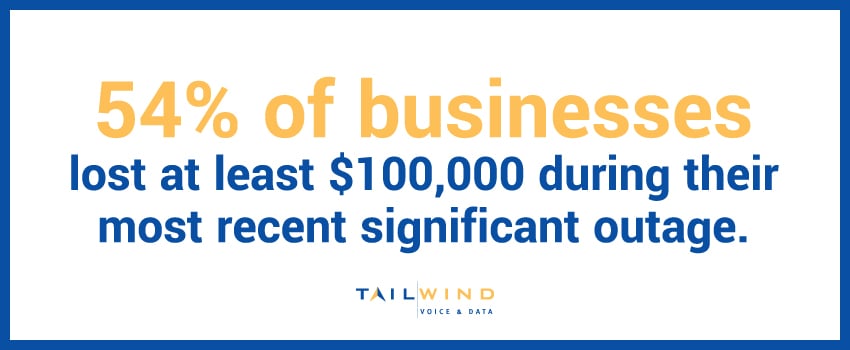
Uptime’s recent survey revealed that over half (54%) of the respondents lost at least $100,000 during their most recent significant outage, and 20% lost more than $1 million.2
Why Is The Cost Of IT Downtime Often Underreported?
Many organizations underestimate their true downtime IT cost because they only account for the immediate, visible losses. The slower costs – diminished employee morale, increased churn risk, and the IT hours spent building workarounds – often don't make it into post-incident reports.
A thorough network downtime report after any significant event should capture all of these dimensions to give leadership an accurate picture of the real cost of network downtime.
6 Common Causes Of Network Downtime
Before you can reduce network downtime, you need to understand where it comes from. Some of the most common causes include:
- Hardware Failure: Aging switches, routers, or cabling that fails without warning.
- Software and Firmware Bugs: Patches that introduce unexpected conflicts.
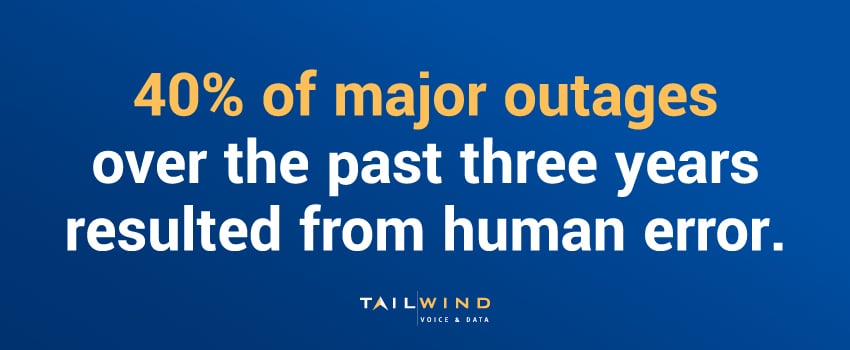
- Human Error: Misconfigurations or mistakes made during routine maintenance, which accounted for 40% of significant outages over the past three years.3
- Cybersecurity Incidents: DDoS attacks, ransomware, or network intrusions that disrupt service.
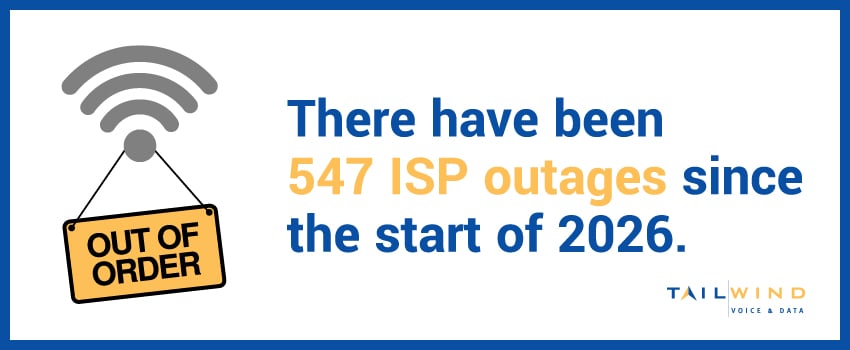
- ISP Outages: There have been 547 ISP outages since the start of 2026,4 which are third-party failures outside of your direct control.
- Power Disruptions: Outages or fluctuations that affect your network equipment.
For multi-location businesses, any one of these issues can affect a single site, then cascade across your entire network infrastructure.
How To Reduce Network Downtime
Knowing the risk is one thing. Taking meaningful action is another. Here's how to reduce network downtime across your organization:
Make Redundancy A Priority
Network redundancy is one of the best ways to eliminate network downtime caused by single points of failure. This means having backup circuits, failover paths, and redundant hardware in place so that when one component fails, traffic automatically reroutes without disruption.
Our Broadband Aggregation service is built specifically for this purpose. We combine multiple internet connections from different carriers into a single, resilient solution. If one provider experiences an outage, your traffic shifts to another without you having to lift a finger.
Implement 24/7 Network Monitoring & Alerting
You can't fix what you don't know about. A network downtime alert system gives your team real-time visibility into performance degradation and outages – often before users even notice something is wrong.
Our NOCaaS (Network Operations Center as a Service) solution provides around-the-clock monitoring, proactive alerting, and rapid response across all your locations. Our team catches and addresses issues that might cause downtime immediately, reducing important metrics like your mean time to detect (MTTD) and mean time to resolve (MTTR).
Conduct Regular Network Assessments
Network assessments like TailWind’s WiFi Surveys and Asset Audits can help you identify threats like aging equipment, security gaps, and configuration vulnerabilities before they become outages.
Our engineers conduct thorough site assessments to identify risks across your infrastructure, giving you the network downtime report data you need to prioritize investments proactively rather than reactively.
Standardize & Document Your Infrastructure
Enterprises that have grown through acquisitions or rapid expansion tend to have ad hoc networks, which are a major source of unplanned downtime. Inconsistent configurations, undocumented devices, and too many vendor relationships make it challenging to diagnose and resolve issues quickly.
Structured cabling and professional stage and configuration services help standardize your infrastructure from the ground up. Troubleshooting becomes faster, and outages become less frequent when every location is built and documented consistently.
Work With A Single Point Of Contact
A major hidden driver of prolonged downtime is a lack of vendor coordination. When your ISP blames your hardware vendor, your hardware vendor points to your carrier, and your carrier is on hold, your network stays down while you play referee.
As an enterprise Carrier Services provider, TailWind becomes your single point of contact across all carriers, vendors, and locations. We own the problem from first alert to full resolution – so you're never stuck managing multiple vendor escalations during an outage.
Can You Eliminate Network Downtime Entirely?
The honest answer is no, you can't fully eliminate network downtime. But you can get very close to it. The goal for most enterprises isn't zero downtime; it's maximum uptime with minimum disruption when failures do occur.
The organizations that come closest to eliminating network downtime share a few things in common: they've invested in redundancy, they have proactive monitoring in place, their infrastructure is documented and standardized, and they have a trusted partner handling escalations before problems become crises.
That's the model we help our customers build.
Reduce Network Downtime With TailWind
Network downtime is expensive, disruptive, and – with the right approach – largely preventable. Whether you're looking to reduce network downtime across multiple locations or build the redundancy your business needs to stay online no matter what, TailWind is here to help.
Our team works 24/7 to monitor your network, detect issues before they impact your operations, and respond immediately when problems occur. We provide the redundancy, monitoring, and single-point-of-contact support that keeps your network online and your business running.
Get in touch with the TailWind team today!
Sources:
- https://www.ciodive.com/news/IT-outages-cost-new-relic/760575
- https://intelligence.uptimeinstitute.com/resource/annual-outage-analysis-2025
- https://uptimeinstitute.com/uptime_assets/d7c049ef5b02a6e0a15540a3e5cb8fbf742c7fa54a1af6caeaaab32b7c15d443-GA-2025-05-annual-outage-analysis.pdf
- https://www.networkworld.com/article/4113326/2026-network-outage-report-and-internet-health-check.html