Choosing the right internet type for your business is a major decision, as 95% of businesses say unreliable connectivity leads to higher operational costs and inefficiencies.1 But with so many options – including fiber, broadband, and WiFi – it’s easy to feel unsure about what will actually deliver the performance your teams need.
In this blog, we’ll explain the differences between fiber internet vs WiFi, explore the pros and cons of each, and help you understand how these technologies work together to provide speed, reliability, and flexibility across your organization.
What Is Fiber WiFi?
The term fiber WiFi can be confusing because it makes it sound like WiFi itself is made of fiber. Actually, it refers to a fiber internet connection that is delivered wirelessly to end users through WiFi access points.
Here’s how it works in a typical business setup. Fiber-optic cables transmit data using light signals to bring fast internet to your building. Once the connection reaches your router or gateway, it’s distributed wirelessly to devices like laptops, tablets, and smartphones through WiFi access points.
This setup combines the strengths of both technologies – fiber provides the high-speed, reliable connection your network depends on, and WiFi makes it accessible across your workspace. Together, they create a flexible environment that supports both stationary and mobile users.
Is Fiber Internet Wireless?
No, fiber internet is not wireless. It relies on physical fiber-optic cabling – usually installed underground or along utility lines – to transmit data between locations. Once the fiber line reaches your building, you can connect end-user devices directly through Ethernet cables or distribute the signal wirelessly through access points.
In short, the connection itself is wired, but how you use it can be wireless. At TailWind, we help businesses implement hybrid networks using structured cabling and wireless solutions built for optimal coverage, security, and performance.
What Is Wireless Broadband?
Wireless broadband delivers internet without physical cables, typically through cellular towers or fixed wireless transmitters. It's often used to connect temporary work sites, businesses in rural areas, or locations where wired infrastructure isn’t available.
Common types of wireless broadband include:
- 4G/5G fixed wireless
- Satellite internet
- Point-to-point microwave links
These solutions provide reliable backup connections or can even serve as the primary option where fiber hasn’t yet reached.
Broadband vs Fiber: What's The Difference?
Although people often use “broadband” and “fiber” interchangeably, they aren’t the same. Broadband refers to any high-speed internet connection, while fiber uses light signals through fiber-optic cables. Here’s a quick comparison:
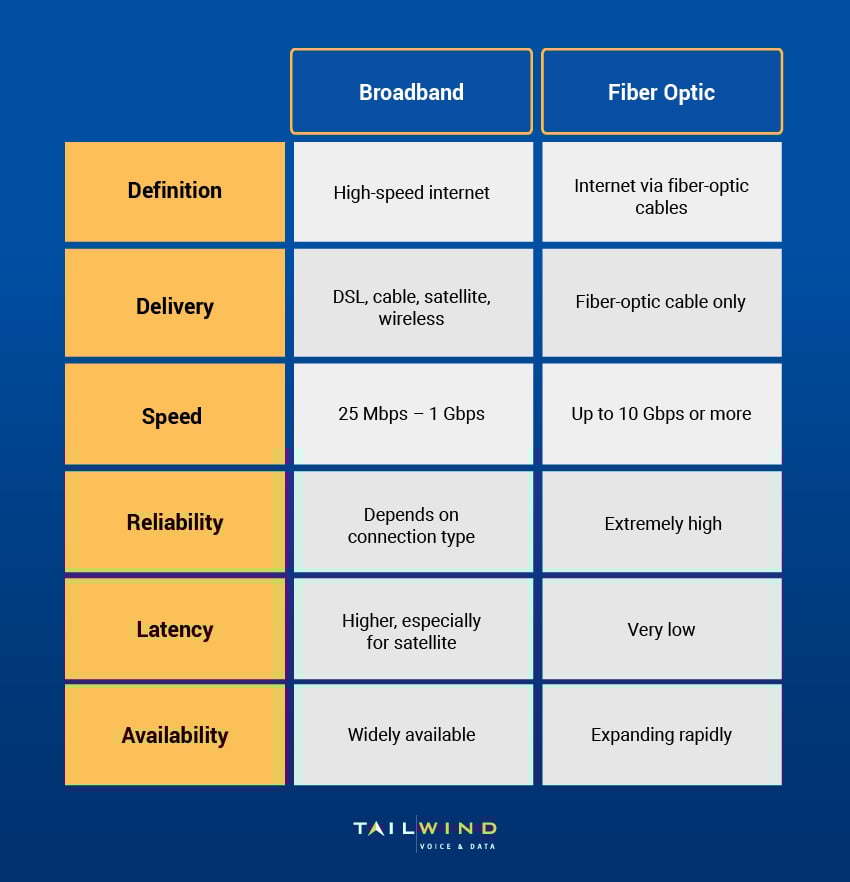
So, is broadband the same as fiber? Not at all – fiber is a type of broadband, but not all broadband connections use fiber.
Is Broadband The Same As WiFi?
No. Broadband refers to the internet connection that enters your building, while WiFi is the wireless network that distributes that connection inside.
In other words, broadband delivers the internet to your site, and WiFi lets your users access it from their devices. They work together, not in competition.
Fiber Internet vs WiFi: Pros & Cons
When evaluating fiber internet vs WiFi, it’s important to understand how they work together – and when they might not be suited for your connectivity needs.
Fiber Internet Pros & Cons
Fiber internet offers unmatched speed, stability, and low latency, which is a must for businesses that rely on real-time tools. It also performs well under heavy loads and is less affected by interference or environmental factors than other broadband types.
The trade-off is that fiber installation can cost more upfront, particularly in new construction or remote areas where cabling isn’t available yet. And while fiber now passes more than 56% of U.S. households and businesses,2 there are still many areas that don’t support this connectivity type yet.
WiFi Pros & Cons
WiFi delivers flexibility and mobility by enabling employees, guests, and IoT devices to connect from anywhere within the building without cables. It’s also a more scalable solution than wired broadband options, so it’s easy to expand coverage or add new users. Its main challenges are signal interference, reduced performance when too many users are connected, and the need for ongoing security management.

Is Fiber Internet Better Than WiFi?
From a performance perspective, yes – fiber internet is faster and more reliable than WiFi. But that doesn’t mean you shouldn’t use WiFi as well.
Here’s how we explain it to our clients:
- Fiber is the high-speed connection that powers your entire network.
- WiFi is the user-friendly way to access that connection.
You need both working together to get the best experience. That’s where TailWind comes in. We design and manage full-stack solutions, from structured cabling to WAP configuration, to ensure your team stays connected without compromise.
Potential Disadvantages Of Fiber Optic Internet
Despite the many benefits, fiber isn’t perfect. Some disadvantages of fiber optic internet include:
- Higher Costs: Installation costs can be higher than other broadband options, especially if new trenching or long cable runs are required.
- Fragility: Fiber cables require careful handling, as they’re more fragile than copper wiring.
- Limited Compatibility: Devices still need Ethernet ports or WiFi to use fiber.
That’s why it’s important to assess your site layout and long-term goals before committing to a full fiber deployment. In some cases, wireless broadband or hybrid setups may make more sense.
Should You Choose Fiber, WiFi, Or Wireless Broadband?
Your business doesn’t have to choose only one of these options – you can (and probably should) use a combination.
For example, a retail chain might use fiber for its point-of-sale systems and WiFi to give its in-store customers guest access, while a healthcare provider could rely on wireless broadband in remote clinics and fiber at its main offices. Multi-location enterprises often combine all three to maintain consistent service and centralized control.
TailWind helps customers across industries find the right setup. Our nationwide team handles site surveys, installs, structured cabling, WAP configuration, and vendor coordination to ensure your network is always aligned with your business needs.
Build A Network That Works For You With TailWind
Still wondering which choice makes the most sense for your business? Whether you're weighing fiber internet vs WiFi or just exploring your options, TailWind is here to help.
We take a hands-on approach to network design and support to ensure every connection, wired or wireless, aligns with your goals. From installation to ongoing maintenance, our experts make it easier to keep your business connected at every location.
Contact TailWind today to learn more about how our network solutions can support your business growth with the right mix of fiber and wireless connectivity.
Sources: