Even the most carefully planned cable run is only as reliable as the connector at each end of it – and using the wrong connector for the application is one of the most common and preventable causes of network performance problems.
Understanding the different wire connector types used in commercial IT and telecom environments can help you ask the right questions for your infrastructure needs. In this guide, we’ll cover the connectors you'll encounter in commercial deployments and share tips to help you select the connector type that’ll keep your network performing reliably.
TL;DR
-
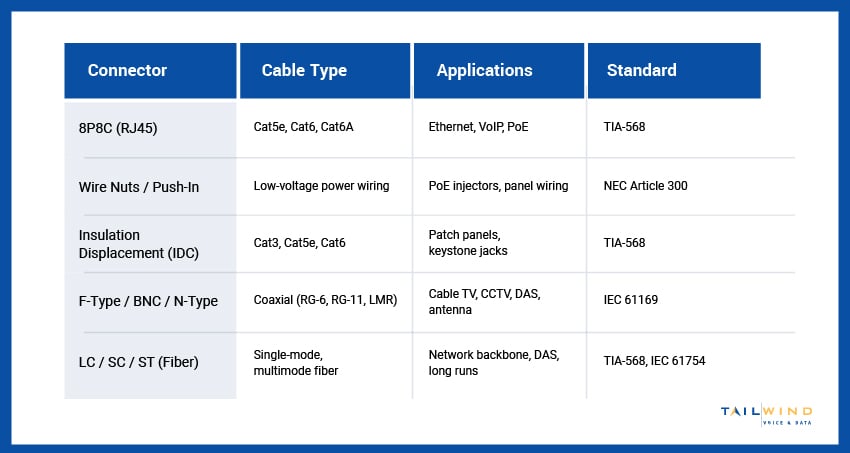
Cable connector types map to specific cable families: RJ45 for Ethernet, F-type, BNC, and N-type for coax, and LC, SC, and ST for fiber, with wire nuts, push-in, and IDC connectors handling low-voltage work.
-
The right connector depends on the cable type and diameter, the environment (outdoor or plenum ratings), the performance spec you are certifying to, and the installation method, since each type needs its own calibrated tool.
-
A cable run is only certified to its lowest-rated part, so a Cat6A channel needs every cable, connector, panel, and patch cord rated to Cat6A; one lower-rated component downgrades the entire run.
Types Of Cable Connectors Used In Commercial IT Infrastructure
Commercial IT and telecom installations involve several distinct categories of cable connectors, each designed for a specific cable type and application. The choices made at the connector level affect signal integrity, installation time, long-term reliability, and code compliance.
Types Of Electrical Connectors For Data & Ethernet
The RJ45 connector is the standard Ethernet connector for every commercial network installation – terminating Cat5e, Cat6, and Cat6A cable at wall jacks, patch panels, and equipment ports.
Cat6A cable, which more than 55% of enterprises transitioned to by 2024,1 requires Cat6A-rated connectors because the larger diameter cable won't seat correctly in a Cat6 plug. PoE+ and PoE++ applications also require connectors and patch panels explicitly rated for the power levels involved.
Low-Voltage Electrical Wire Connectors Types
Commercial IT and telecom installations can involve low-voltage power wiring for PoE injectors, UPS systems, panel wiring, and equipment interconnects. The connector types that cover most of this work include:
- Wire nuts (twist-on connectors), which are color-coded by conductor count and gauge, code-compliant, and widely available – though prone to loosening under vibration in equipment rooms.
- Push-in connectors (WAGO-style) are faster to install, more vibration-resistant, and increasingly common in commercial enclosures.
- IDC (insulation displacement) connectors, which are used for patch panel and keystone jack terminations in structured cabling – the conductor presses into a V-slot that cuts through the insulation, creating a fast, consistent connection using a standard 110 punch-down tool.

Different Types Of Wire Connectors For Coaxial Cable
Coaxial cable connectors appear across a range of commercial applications – from cable TV distribution and CCTV to DAS antenna runs. These types cover the majority of commercial coax work:
F-Type
F-type connectors are the standard for cable TV, satellite, and broadband coax (RG-6) installations. They’re available in crimp, compression, and push-on styles, but compression connectors must be installed with a calibrated tool.
BNC
BNC is common in CCTV and professional video. It’s faster to connect and disconnect than threaded connectors, making them practical in environments where cables are regularly reconfigured.
N-Type
N-type connectors are threaded, weatherproof, and rated for higher frequencies than F or BNC. As a result, they’ve become the standard for outdoor antenna systems, and DAS runs using LMR-400 or LMR-600 cable. They require precise installation and proper torque to perform to the rated spec.
Types Of Wire Connectors For Fiber Optic Cable
Use of fiber optics has increased by 38% across new structured cabling installations.1 However, fiber optic connectors are mechanically and optically precise, so even minor contamination on the connector face can cause measurable signal loss.
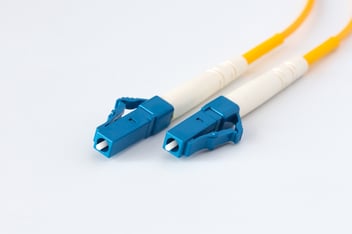
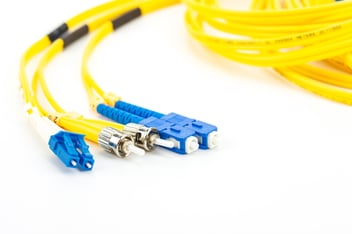
The three connector types you'll encounter in commercial fiber deployments are:
- LC (Lucent Connector), which is the enterprise standard. Its small form factor supports high port density, and it’s used in virtually all SFP/SFP+ transceiver modules.
- SC (Subscriber Connector) is larger, uses a push-pull coupling, and remains common in telecom and DAS applications.
- ST (Straight Tip) uses a bayonet twist-lock. This is a legacy type that you may encounter when working with existing infrastructure, but it is rarely specified for new builds.
The connector choice and termination quality will directly affect system performance for any project involving fiber backbone runs, cross-connects, or DAS infrastructure. At TailWind, our structured cabling team can terminate and certify your fiber connections to TIA and IEC standards for every installation, with OTDR testing and documented insertion-loss measurements as standard deliverables.
How To Choose Wire Connectors Types For Your Application
Selecting the right connector comes down to four criteria:
Cable Type & Size
Every connector is engineered for a specific cable family and diameter. If you use the wrong type or size, it can result in poor contact, signal degradation, and failed certifications.
Application & Environment
Outdoor and plenum installations require connectors rated for those conditions. UV resistance, weatherproofing, and plenum-rated materials aren’t optional in those environments.

Performance Specification
A Cat6A channel is only certified to Cat6A if every component, including the cable, connectors, patch panels, and patch cords, is rated to Cat6A. Mixing lower-rated components anywhere in the channel downgrades your entire run.
Installation Method
Installing the right connector with the wrong tool will produce a connection that may look fine but fail under testing. Professional installations use calibrated tools specific to each connector type – coax compression tools, punch-down tools, and fiber cleave/polish equipment.
Cable & Wire Connector Types FAQs
What Are The Main Types Of Cable Connectors Used In Commercial IT?
Commercial IT and telecom installations use several distinct connector categories, each matched to a specific cable type and application. For data and Ethernet, the RJ45 is the standard. Coaxial cable uses F-type, BNC, or N-type connectors depending on the application. Fiber optic cable uses LC, SC, or ST connectors. Low-voltage power and structured cabling terminations rely on wire nuts, push-in connectors, and insulation displacement connectors. The category you choose affects signal integrity, installation time, long-term reliability, and code compliance, which is why connector selection is treated as an engineering decision rather than an afterthought.
What Connector Is Used For Ethernet Cable?
The RJ45 connector is the standard for Ethernet in every commercial network, terminating Cat5e, Cat6, and Cat6A cable at wall jacks, patch panels, and equipment ports. The important detail is matching the connector to the cable rating. Cat6A cable has a larger diameter and will not seat correctly in a Cat6 plug, so it needs Cat6A-rated connectors. If you are running Power over Ethernet, the connectors and patch panels must also be explicitly rated for the PoE+ or PoE++ power levels involved.
What Are The Different Types Of Coaxial Cable Connectors?
Three coax connectors cover most commercial work. F-type is the standard for cable TV, satellite, and broadband coax on RG-6, and comes in crimp, compression, and push-on styles, though compression versions need a calibrated tool. BNC uses a quick twist-lock that connects and disconnects fast, which makes it common in CCTV and professional video where cables are reconfigured often. N-type is threaded, weatherproof, and rated for higher frequencies, so it is the standard for outdoor antenna systems and DAS runs on LMR-400 or LMR-600 cable, where correct torque during installation is essential.
What Are The Types Of Fiber Optic Connectors?
Commercial fiber deployments use three connector types. LC (Lucent Connector) is the enterprise standard; its small form factor supports high port density and it appears on virtually all SFP and SFP+ transceiver modules. SC (Subscriber Connector) is larger, uses a push-pull coupling, and remains common in telecom and DAS applications. ST (Straight Tip) uses a bayonet twist-lock and is a legacy type you may meet in existing infrastructure but rarely see specified for new builds. Because fiber is optically precise, even minor contamination on the connector face can cause measurable signal loss.
How Do You Choose The Right Cable Connector?
Selecting the right connector comes down to four criteria. First, cable type and size: every connector is engineered for a specific cable family and diameter, and the wrong fit causes poor contact and failed certifications. Second, application and environment: outdoor and plenum installations need connectors rated for UV, weather, or plenum use. Third, performance specification: the connector has to match the channel rating you are certifying to. Fourth, installation method: each connector type needs its own calibrated tool, because the right connector installed with the wrong tool can look fine yet fail under testing.
Can You Mix Different Connector Ratings In One Cable Run?
Not without downgrading the whole run. A channel is only certified to a given performance level if every component in it, the cable, the connectors, the patch panels, and the patch cords, is rated to that level. For example, a Cat6A channel is only Cat6A if all of its parts are Cat6A; drop in a single Cat6 connector or patch cord and the entire run effectively performs at the lower rating. That is why professional installations standardize on matched, fully-rated components end to end rather than mixing whatever is on hand.
Specify The Right Cabling Infrastructure For Your Project
The connector choices made during infrastructure planning and installation determine whether your network performs reliably for the next 15 years – or becomes a persistent source of troubleshooting headaches.
Getting connector selection right across a large commercial deployment requires the kind of systematic approach that TailWind’s field services team brings to every project. We provide standardized materials, certified installation, and end-to-end testing documentation to ensure every one of your connections performs to spec and carries the warranty it's supposed to.
Whether you're planning a new buildout, upgrading existing cabling, or coordinating infrastructure across multiple locations, our network engineering experts are ready to help you specify and install it correctly. Get in touch to get started – and let's build infrastructure that performs.
Sources: