Managing telecom expenses has always been a challenge for businesses, with many IT teams unable to keep track of every line, circuit, wireless plan, and vendor contract. And as costs build across multiple locations, it becomes even harder to understand what you’re paying for and where savings may be hiding.
A 2025 report from Spiceworks found that 92% of businesses planned to implement cost-saving measures for IT,1 showing just how much pressure organizations feel to manage their technology budgets better. Luckily, the right strategies and partners can help you reduce telecom expenses without sacrificing service quality or functionality.
Read on to learn what drives telecom costs, along with cost reduction tips you can start using today.
What Is a Telecom Fee?
Telecom bills can be confusing, especially when they include long lists of taxes, surcharges, and provider-specific fees. Understanding what a telecom fee is helps your team separate mandatory charges from optional or incorrect ones.
Telecom fees often include:
- Regulatory charges at the federal or state level
- Universal service fees
- E911 fees
- Administrative or recovery fees added by the provider
- Modem or router rental fees
- Maintenance or protection plan charges
Some fees are unavoidable, while others arise from contract terms or service add-ons. There are also cases where fees remain on your account long after a service contract has changed.
TailWind’s telecom expense audits can help you understand these fees and identify issues like billing errors or duplicate charges, so it’s easier to uncover telecom expense reduction opportunities.
Common Telecom Cost Control Challenges
Many businesses struggle to reduce telecom expenses due to obstacles like:
Lack of a Central Inventory
It can be difficult to manage telecom expenses without a complete list of your circuits, lines, wireless plans, and devices across every location.
Multiple Vendors
Working with several ISPs and carriers creates inconsistent pricing, complex billing, and limited leverage for negotiations.
Billing Errors
Providers sometimes bill for disconnected circuits, apply incorrect rates, or charge for unused features. Without regular audits, these errors can go unnoticed for months or years.
Auto-Renewing Contracts
Many telecom contracts renew automatically at higher prices unless you renegotiate early. Tracking renewal dates can help your teams secure better rates before the renegotiation period ends.
Unclear Ownership
Telecom costs often fall between departments. Your IT team likely understands the services, while your finance team handles invoices. Without shared visibility across these departments, it can be harder to reduce costs.
8 Strategies for Telecom Cost Reduction
Ready to reduce your telecom costs? Here are strategies to help you get started:
1. Document Your Inventory
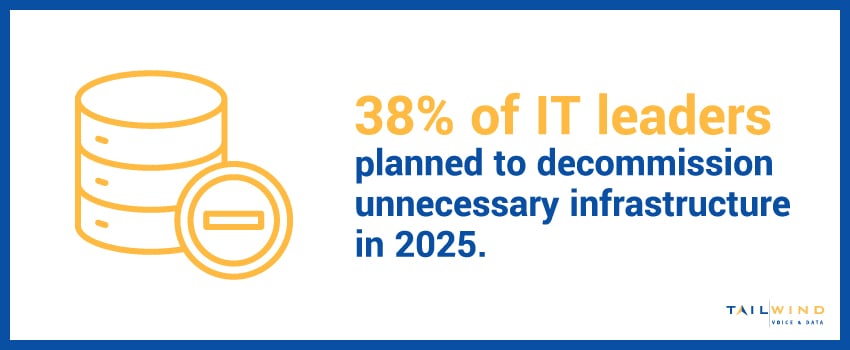
According to the 2025 Spiceworks report, 38% of IT leaders planned to decommission unnecessary infrastructure.1 However, you can’t take cost-saving steps like this without understanding your assets. Once you’ve inventoried the circuits, phone lines, numbers, equipment, wireless plans, and vendors for each location, you can identify services that are no longer needed or duplicated.
2. Conduct Regular Audits
Billing errors are more common than many realize. Providers may charge incorrect rates, include discontinued services, or apply unexpected fees.
A telecom audit can help you verify:
- Contracted rates versus billed rates
- Active versus inactive services
- Long-distance and usage charges
- Accuracy of taxes and surcharges
Regularly performing telecom audits can help prevent costs from creeping back up over time.
3. Consolidate Vendors
When you work with multiple carriers across sites, you have to deal with different billing practices, support processes, and contract terms.
Consolidating vendors through a single carrier services partner like TailWind simplifies telecom management while improving service quality. We handle negotiations, contract reviews, and ongoing relationship management on your behalf so that you always receive competitive pricing and responsive support.
4. Improve Visibility
Centralized expense dashboards let your IT and finance teams view all services, contracts, and usage in one place. This shared visibility makes it easy to spot issues like unusual charges, outdated contracts, or inactive circuits faster.
5. Leverage NOCaaS
Without proactive monitoring, network issues can go undetected until they impact operations – leading to emergency support calls, expedited repairs, and productivity losses that far exceed the original problem's cost.
TailWind's Network Operations Center as a Service (NOCaaS) solutions reduce downtime by catching potential problems before they escalate. Our U.S.-based technical support team becomes an extension of your IT department, reducing the burden on internal IT staff while ensuring reliable connectivity across your enterprise.
6. Right-Size Bandwidth
You may be paying for excess bandwidth at some locations, while others consistently suffer from slow speeds. A usage assessment can help you:
- Downgrade any excessive bandwidth
- Upgrade circuits that slow down operations
- Replace older technologies with more efficient options
This approach balances performance and cost so each location gets exactly what it needs.
7. Optimize Your Infrastructure
Outdated telecom systems lack the flexibility and features of modern solutions, which often results in higher operating costs and limited scalability.
Optimize your infrastructure by assessing structured cabling systems, replacing aging equipment, and implementing technologies like SD-WAN that provide more cost-effective connectivity.
8. Implement TEM
A telecom expense management (TEM) provider handles audits, inventory tracking, vendor negotiations, billing reviews, and contract lifecycle management on your behalf. This is especially valuable for multi-location businesses without dedicated internal resources.
The right TEM partner can help you:
- Reduce telecom expenses across all locations
- Identify and recover overcharges
- Manage vendors more effectively
- Improve budgeting accuracy
- Maintain long-term telecom cost control
TailWind works with multi-location businesses across North America to streamline telecom expense management with end-to-end billing automation, service usage analysis, dispute resolution, and more.
Make Telecom Expense Reduction a Reality With TailWind
Reducing telecom expenses doesn't have to mean compromising on service quality or capabilities when you have the right processes and support in place.
At TailWind, we help enterprises save on telecom costs while improving service quality and simplifying vendor management. Our suite of TEM services provides everything you need to gain control over your telecom costs and redirect those savings toward more strategic initiatives.
Book a meeting with our team today to discover how much you could save on telecom costs.
Sources: