
Most enterprise networking technology from the early 2000s is long gone, but MPLS is an exception. It still anchors WAN connectivity across thousands of multi-site enterprises more than twenty years on – particularly those with stringent performance, security, or compliance requirements – even as SD-WAN and cloud-first architectures reshape everything around it.
The market reflects this staying power, with managed MPLS in North America representing around $27.7 billion annually at a projected 4.4% growth rate through 2026.¹ Read on to learn how MPLS works and how it compares to alternatives like SD-WAN and standard VPN, so you can evaluate whether it still fits your business needs in 2026.
TL;DR
-
MPLS (Multiprotocol Label Switching) is a routing technique that forwards data using short path labels instead of full IP address lookups, typically delivered as a private, carrier-managed WAN connecting multiple business locations.
-
Label switching gives MPLS its core enterprise benefits: QoS that prioritizes voice and video, steady latency and jitter on engineered paths, and carrier SLAs that standard internet connections can’t match.
-
MPLS VPNs keep each customer’s traffic logically separate on shared carrier infrastructure, but that traffic isn’t encrypted, so regulated data still needs IPSec or MACsec on top.
-
SD-WAN over a dedicated 1 Gbps circuit costs about 25% less per month than equivalent MPLS, so most enterprises now run SD-WAN as their primary WAN and keep MPLS for critical traffic.
What Is MPLS?
MPLS is a routing technique that moves data between network nodes using short path labels instead of long network addresses. This lets it avoid the complex lookups required in a traditional routing table.
An MPLS network assigns labels to packets when they enter, and makes subsequent forwarding decisions based on the label rather than the underlying packet's destination IP address. This produces faster forwarding, more predictable performance, and the ability to engineer traffic paths in ways that traditional IP routing can't.
For enterprises, the MPLS network meaning translates to one thing: a private, carrier-managed WAN with strong service-level guarantees connecting multiple business locations.
What Does MPLS Stand For?
MPLS stands for Multiprotocol Label Switching. "Multiprotocol" because it can carry many types of traffic (IP, Ethernet, ATM, frame relay), and "label switching" because forwarding decisions are made using labels attached to packets rather than full address lookups.
While newer technologies have emerged, MPLS is still popular because it solves performance, traffic engineering, and QoS problems that consumer-grade internet connectivity just can’t.

How An MPLS Network Works: MPLS Network Diagram In Concept
An MPLS network diagram conceptually consists of three types of routers and the labels that move between them:
- Provider Edge (PE) Routers: Sit at the edge of the carrier's MPLS network and connect to customer locations. PE routers assign labels to incoming packets based on classification rules – type of traffic, customer, destination.
- Provider (P) Routers: Sit inside the carrier's network and forward packets based purely on their labels. P routers don't perform IP lookups, which makes their forwarding very fast.
- Customer Edge (CE) Routers: Sit at the customer site and connect to the PE router. They run standard IP routing protocols and have no direct knowledge of MPLS labels.
When a packet enters the MPLS cloud at a PE router, it's tagged with a label that identifies its Label Switched Path (LSP). The packet then traverses the network from P router to P router, with each router using only the label to determine the next hop. When the packet reaches the egress PE router, the label is stripped, and the packet is forwarded to its final destination via standard IP.
Key Benefits Of MPLS For Multi-Site Enterprise WANs
MPLS has held its place in enterprise WANs because of what label-based forwarding makes possible inside a carrier network. Three benefits come straight from how it moves traffic, and a fourth, keeping each customer’s traffic separate on shared infrastructure, is the basis of MPLS VPN, covered in the next section.
Faster Packet Forwarding Without Per-Hop IP Lookups
In standard IP routing, every router reads a packet’s destination address and searches its routing table before passing it on. MPLS makes that decision once, at the edge of the carrier network. From there, P routers forward each packet based on a short, fixed-length label. Modern routers handle IP lookups in hardware, so the gain today is less about raw speed and more about consistency: every packet in a given class is handled the same way at every hop.
Quality of Service (QoS) For Voice & Video Traffic
MPLS services typically include several classes of service, and each class gets a different priority in the carrier’s queues. Voice and video conferencing go in the top class, business applications in the middle, and bulk traffic like backups and file syncs at the bottom. When a link gets busy, the low-priority traffic waits instead of your calls. That’s also why QoS marking between the CE and PE routers matters: traffic only gets priority if it’s classified correctly when it enters the network.
Predictable Latency & Jitter On Engineered Paths
Because labels map traffic to predetermined label-switched paths (LSPs), packets between two sites follow the same route every time instead of shifting as routing tables change. Carriers can also use traffic engineering to steer those paths around congested links and reserve capacity along them. The result is steady latency and low jitter. That consistency is what allows carriers to back MPLS with SLAs on delay, jitter, and packet loss.
How MPLS VPN Creates Private Networks
MPLS VPN is the most common enterprise use case for MPLS. An MPLS VPN – sometimes referred to as an MPLS private network – uses the MPLS network to create logically separated private networks for individual customers, all sharing the same physical carrier infrastructure.
Two MPLS VPN configurations lead enterprise deployments:
Layer 3 MPLS VPN (L3VPN)
In an L3VPN, the carrier participates in routing between customer sites. Each customer's traffic is kept logically separate using VRFs (Virtual Routing and Forwarding instances). This is the most widely deployed MPLS VPN type.
Layer 2 MPLS VPN (L2VPN/VPLS/VPWS)
In an L2VPN, the carrier transports the customer's layer-2 traffic transparently so that multiple sites appear as if they're on the same LAN. This is the foundation of many metro Ethernet services.
MPLS VPN Security: How Secure Is MPLS?
MPLS VPN security is one of the most frequently misunderstood topics in enterprise networking. MPLS VPN traffic is logically isolated between customers on the carrier network – but it is not encrypted. Traffic moving across the MPLS backbone is private only in the sense that other customers can't see it through the carrier's labeling mechanism.
Businesses that need true encryption, such as those handling regulated data, typically deploy additional encryption layers like IPSec or MACsec on top of the MPLS VPN.
Who Handles MPLS VPN Configuration?
MPLS VPN configuration is a carrier responsibility, not a customer task, because the complexity of label distribution protocols (LDP), routing protocol extensions (MP-BGP), and VRF management lives inside the carrier's network.
The customer's role typically involves:
- Configuring CE router connectivity to the PE router
- Defining routing relationships (BGP, OSPF, or static) between CE and PE
- Coordinating QoS marking and traffic classification with the carrier
- Managing internal LAN-side configuration at each site
This delivery model is one of MPLS's biggest operational advantages – and one of its highest costs. Carriers do the heavy lifting, but you pay for it in monthly service fees.
Standard VPN vs MPLS
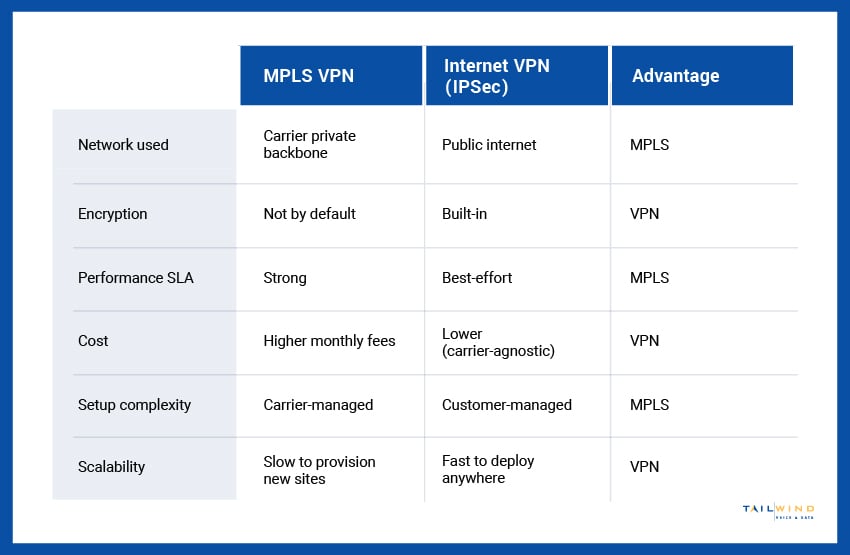
The MPLS vs. VPN comparison gets confused because MPLS itself supports VPN configurations (MPLS VPN), while the more common consumer/enterprise meaning of "VPN" refers to encrypted tunnels over the public internet.
Choosing the right one for your organization will depend on what you want to protect and prioritize. MPLS VPN wins wherever you need predictable, SLA-backed performance, while an internet VPN wins where built-in encryption, low cost, and fast deployment matter more than guaranteed latency.
Here's how they compare in practice:
SD-WAN vs MPLS
SD-WAN (Software-Defined Wide Area Network) abstracts the WAN from the underlying transport, which lets businesses use a mix of broadband, fiber, LTE, and even MPLS circuits while centrally managing routing, security, and policy.
For most enterprises in 2026, SD-WAN is the appropriate primary architecture – often with a residual MPLS circuit for specific high-priority traffic. At TailWind, we offer SD-WAN solutions that help enterprises navigate that transition.
Here are the key differences between SD-WAN and basic MPLS solutions:
Transport Flexibility
SD-WAN can run over any underlying connection, including broadband, fiber, LTE, and existing MPLS circuits.
MPLS is its own dedicated private network. That difference is what lets SD-WAN mix and match transports to fit each site rather than locking every location into one carrier service.
Application Performance
MPLS still wins for absolute predictability, delivering guaranteed latency and jitter that real-time workloads depend on.
SD-WAN wins for cloud-first traffic patterns, as it routes SaaS and internet-bound traffic directly instead of backhauling it through a central data center.
Provisioning Speed
SD-WAN sites can be deployed in days, often using whatever broadband or wireless transport is already available locally.
MPLS frequently takes 30 to 90 days because it depends on carrier circuit ordering and turn-up schedules. Businesses opening locations, running pop-up sites, or absorbing acquisitions often find that gap in lead time is the deciding factor.
Cost Structure
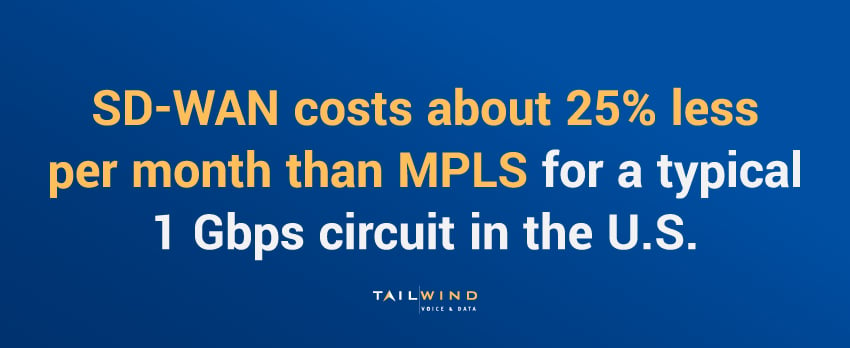
SD-WAN over broadband is cheaper per Mbps than MPLS, since it leverages commodity internet circuits instead of dedicated private bandwidth. For a typical 1 Gbps circuit in the U.S., running SD-WAN over dedicated circuits costs about 25% less per month than equivalent MPLS.2
MPLS still carries better SLA guarantees than broadband, so the comparison depends on which circuits you choose to actually replace the MPLS ones.
Is The MPLS Protocol Still Relevant In 2026?
Despite SD-WAN's growth, the MPLS protocol remains a valid choice for specific use cases:
Strict Performance SLAs
Real-time applications such as financial trading and certain healthcare systems demand guaranteed latency and jitter, and MPLS delivers that consistency. The performance guarantee is what justifies the higher cost for these workloads.
Regulated Industries
Some compliance frameworks favor MPLS's private-network architecture, even where encryption is added on top. The carrier-isolated path can simplify audits and satisfy requirements that are harder to demonstrate over the public internet.
Hybrid WAN Deployments
Many enterprises maintain MPLS for critical traffic alongside SD-WAN for everything else. This hybrid model keeps deterministic performance where it's needed while shifting cloud and branch traffic onto cheaper, more flexible transport.
Inter-Regional Connectivity
MPLS still excels at long-distance, multi-region private connectivity where alternatives don't yet match performance. Across geographies with inconsistent internet quality, a carrier-managed backbone can deliver more predictable site-to-site performance than transport stitched together over public links.
MPLS (Multiprotocol Label Switching) FAQs
Is MPLS A LAN Or WAN?
MPLS is a WAN technology. It connects separate business locations, such as headquarters, branches, and data centers, across a carrier’s network, while each site keeps its own local network behind the customer edge router. The line blurs with Layer 2 MPLS VPNs like VPLS, which carry traffic transparently so that multiple sites behave as if they were on the same LAN, even though the connection between them is still a carrier-managed wide area network.
What Are The Disadvantages Of MPLS?
The biggest drawback is cost, since MPLS bandwidth is priced well above business broadband or dedicated internet access. New circuits often take 30 to 90 days to provision, which slows site openings. MPLS traffic isn’t encrypted by default, so regulated data needs IPSec or MACsec on top. Hub-and-spoke designs also backhaul cloud traffic through a central data center, adding latency for SaaS apps. And because carriers have regional footprints, a nationwide or global MPLS WAN can require contracts with several providers.
Can MPLS Connect Directly To Cloud Applications?
Not by default. An MPLS VPN connects your own sites inside the carrier’s network, while cloud applications live on the public internet or in a cloud provider’s data centers. Traditionally, cloud traffic gets backhauled to a central site with an internet breakout, which adds latency. Some carriers offer private cloud on-ramps that link an MPLS VPN to providers like AWS and Microsoft Azure. Many enterprises instead add local internet breakout at each branch, often through dedicated internet access managed by SD-WAN.
What Is A Forwarding Equivalence Class (FEC) In MPLS?
A forwarding equivalence class (FEC) is a group of packets that the MPLS network forwards the same way, over the same path and with the same treatment. The ingress PE router assigns each packet to an FEC based on criteria like its destination, customer VPN, or traffic class, then attaches the label tied to that FEC. Every packet in the same FEC follows the same label switched path, which is what makes MPLS routing consistent and predictable.
Why Is MPLS Called A Layer 2.5 Protocol?
MPLS sits between two layers of the OSI model. Its 4-byte label header is inserted after the Layer 2 (data link) header, such as Ethernet, and before the Layer 3 (network) IP header. That placement lets routers forward packets using the label alone, without reading the IP header, while still carrying ordinary IP traffic. Because it doesn’t fit cleanly into either layer, network engineers commonly describe MPLS as operating at Layer 2.5.
What Do Push, Swap, And Pop Mean In MPLS?
They’re the three operations routers perform on MPLS labels. A push adds a label when a packet enters the network at the ingress PE router. A swap happens at each P router in the core, which replaces the incoming label with the outgoing label for the next hop. A pop removes the label, either at the egress PE router or one hop before it, so the packet can continue to its destination through standard IP routing.
Leverage MPLS The Right Way With TailWind
MPLS isn't dead – but it's no longer the default. The right answer in 2026 depends on what your business actually needs from its WAN: predictable performance, cost efficiency, cloud-readiness, or some combination.
Whether MPLS, SD-WAN, or a hybrid mix is right for your business depends on your application profile, geographic footprint, and operational priorities. At TailWind, our carrier services team works with enterprises to design the right mix.
Get in touch to get started – and let's build a WAN strategy that fits your business!
Sources: