
Connecting multiple sites in the same metropolitan area reliably and at high bandwidth is a core infrastructure problem for businesses running corporate offices, branch locations, data centers, and manufacturing facilities. Metro Ethernet is the carrier service category built specifically to solve it.
Read on to learn what Metro Ethernet is, how it works, the different service types available, and when it's the right choice for your enterprise connectivity strategy.
TL;DR
-
Metro Ethernet is a carrier service that extends standard Ethernet across a metropolitan area, so businesses can connect multiple local sites like one LAN at symmetrical speeds from 10 Mbps to 100 Gbps.
-
E-Line, E-LAN, and E-Tree are the three MEF-defined Ethernet service types, covering point-to-point links between two sites, multi-site LAN-style connectivity, and hub-and-spoke networks centered on headquarters.
-
Within a single metro area, metro Ethernet usually costs less per Mbps than MPLS, with a 1 Gbps E-Line typically priced around $800 to $2,500 per month in U.S. markets.
What Is Metro Ethernet?
Metro Ethernet is a carrier-delivered connectivity service that extends Ethernet networking – the same protocol your office LAN runs on – across a metropolitan area network (MAN). Rather than building separate private circuits or wrestling with the complexity of WAN protocols, businesses use metro Ethernet to connect multiple sites in the same metro region as if they were on a single extended LAN.
A metro Ethernet network is delivered as a dedicated, symmetrical service with speeds ranging from 10 Mbps to 100 Gbps and carrier-grade SLA backing. It uses native Ethernet, so integrating with existing enterprise infrastructure is straightforward – no protocol translation, no specialized WAN hardware, and no learning curve for IT teams already familiar with Ethernet networking.
Standards for metro Ethernet services are defined by the MEF (Metro Ethernet Forum), with certified service categories ensuring interoperability and performance consistency across carriers.
What Are The Types Of Metro Ethernet Services?
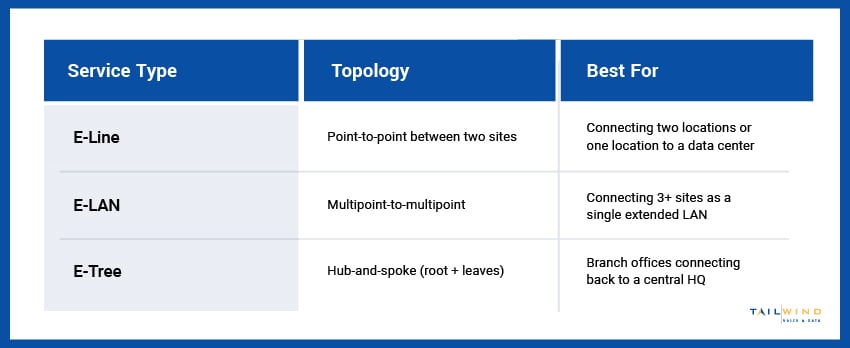
Metro Ethernet services are defined by MEF in three primary categories based on connectivity topology:
-
E-Line is the most common deployment for businesses connecting two specific sites or extending a primary internet circuit.
-
E-LAN is the standard for multi-site enterprises wanting transparent LAN-style connectivity across locations.
-
E-Tree fits hub-and-spoke organizations where branches communicate primarily with headquarters rather than with each other.
Not sure which type is right for your networking needs? TailWind’s engineering experts can evaluate your setup, recommend the best option, and handle implementation nationwide.
How Metro Ethernet Works
Metro Ethernet extends standard Ethernet over a carrier's optical fiber backbone within a metropolitan area. The technical components are:
- Customer Edge Equipment: Each business location connects to the carrier's network through Ethernet-capable equipment at the customer site – typically delivering 1 Gbps or 10 Gbps ports.
- Carrier Backbone: Traffic travels across the carrier's fiber-based metro optical Ethernet infrastructure, which is engineered for low latency and high availability.
- Logical Separation: Multiple customers share the same physical backbone, with each customer's traffic logically isolated using VLANs or similar mechanisms.
- Symmetric Delivery: Upload and download bandwidth is equal – critical for site-to-site replication, cloud backups, and real-time applications.
Together, these components let a business operate geographically separate sites as if they shared one local network, without taking on the cost or complexity of building and maintaining that infrastructure itself.
Metro Ethernet vs MPLS: Compared
MPLS vs Metro Ethernet is one of the most common comparisons businesses make when evaluating WAN connectivity. Both deliver private, carrier-managed connectivity between sites – but they differ in protocol, complexity, and typical use case:
Here’s how they stack up:
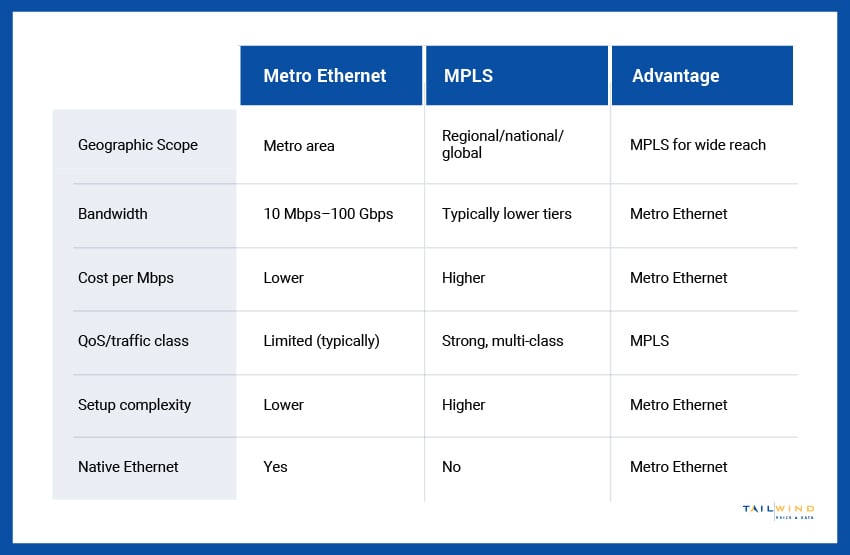
Metro Ethernet vs. MPLS isn't always an either/or choice. Many enterprises use metro Ethernet within metropolitan areas and MPLS for inter-metro connectivity, or replace traditional MPLS with SD-WAN running over metro Ethernet and broadband circuits.
Metro Ethernet vs Fiber: Are They Different?
The metro Ethernet vs. fiber comparison is a common source of confusion because the two terms describe different things at different layers. Fiber refers to the physical transmission medium – the actual glass cable carrying light signals. Metro Ethernet refers to the service delivered over that medium.
In practice, most modern metro Ethernet services are delivered over fiber infrastructure – meaning they are fiber connections. So the meaningful question isn't "metro Ethernet vs. fiber" but rather "what service tier and topology should I use to deliver connectivity over the available fiber infrastructure?"
5 Benefits Of Metro Ethernet For Business
Multi-site enterprises operating within a metropolitan area can expect metro Ethernet to deliver major advantages over alternatives like point-to-point T1s, traditional MPLS, or stitched-together broadband circuits. Let’s explore the biggest benefits below:
1. Scalable Bandwidth
Many metro Ethernet providers offer service tiers from 10 Mbps to 100 Gbps, which allows the capacity your organization needs to match growth without having to change carriers or technology as you add more locations.
2. Simplified Architecture
Because metro Ethernet uses native Ethernet architecture, you don’t have to deal with protocol translation or proprietary WAN hardware when making the switch. Plus, it’s already a familiar operational model for your IT teams.
3. Cost Efficiency
The per-Mbps pricing model for metro Ethernet is significantly lower than MPLS or traditional dedicated circuits at equivalent bandwidth.
4. Carrier-Grade Reliability
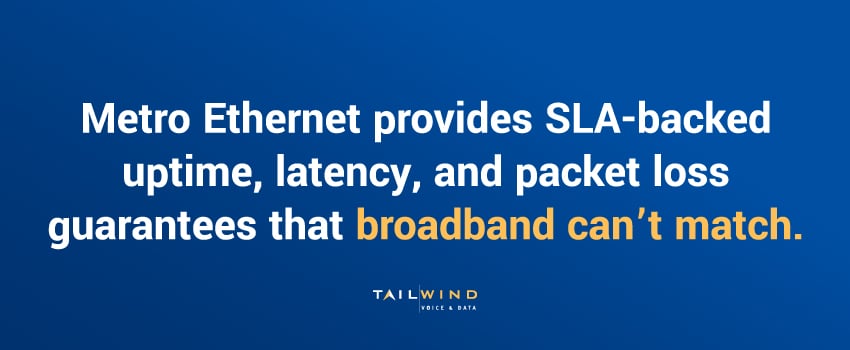
Metro Ethernet services provide SLA-backed uptime, latency, and packet loss guarantees that broadband services simply can’t match.
5. Symmetric Performance
Equal upload and download speeds support modern workloads – cloud backup, video, replication, and remote work.
What To Expect For Metro Ethernet Pricing?
Metro Ethernet pricing varies based on bandwidth, geography, distance to the carrier's nearest fiber point of presence, and contract length. Here are the typical ranges in U.S. commercial markets:
- 100 Mbps E-Line: ~$400–$1,200/month
- 1 Gbps E-Line: ~$800–$2,500/month
- 10 Gbps E-Line: ~$2,500–$8,000+/month
- E-LAN multi-site: Per-site rates similar to E-Line, plus a logical service charge
Installation fees are sometimes waived for longer-term contracts in fiber-rich areas, but can cost several thousand dollars when new fiber construction is required.
How To Choose The Right Metro Ethernet Service Provider
Choosing a metro Ethernet service provider depends on more than just price per Mbps. Consider these factors when comparing vendors for your enterprise deployments:
- Network Reach: Confirm the provider's fiber footprint actually serves every location you need.
- SLA Terms: Uptime guarantees, MTTR commitments, and credit structures vary between carriers.
- Multi-Site Management: Single point of contact, consolidated billing, and centralized monitoring matter as your site count grows.
- Upgrade Flexibility: Confirm bandwidth can scale on the existing infrastructure without recabling or service changes.
Evaluating metro Ethernet across multiple locations? TailWind’s carrier services and broadband aggregation teams leverage relationships with major and regional carriers to source the right circuits at the right pricing – managed under one relationship across every site.
Metro Ethernet FAQs
What Is Metro Ethernet?
Metro Ethernet is a carrier-delivered service that carries Ethernet, the same protocol your office LAN uses, across a metropolitan area network. It lets a business link offices, branches, data centers, and manufacturing facilities in the same metro region so they operate like one extended LAN. Service is dedicated and symmetrical, comes with carrier-grade SLAs, and plugs into existing enterprise infrastructure without protocol translation or specialized WAN hardware.
How Does Metro Ethernet Work?
Each site connects to the carrier through Ethernet-capable customer edge equipment, usually with 1 Gbps or 10 Gbps ports. From there, traffic travels across the carrier’s metro fiber backbone, which is engineered for low latency and high availability. Many customers share that physical backbone, but VLANs or similar mechanisms keep each customer’s traffic logically isolated. Bandwidth is delivered symmetrically, so sites can replicate data and run real-time applications at the same speed in both directions.
What Are The Three Types Of Metro Ethernet Services?
The MEF defines three primary service types based on connectivity topology. E-Line is the most common, used to connect two specific sites or extend a primary internet circuit. E-LAN is the standard for multi-site enterprises that want transparent LAN-style connectivity across all their locations. E-Tree fits hub-and-spoke organizations, where branches communicate mainly with headquarters rather than with each other.
How Fast Is Metro Ethernet?
Metro Ethernet service tiers typically range from 10 Mbps up to 100 Gbps, and customer sites usually connect through 1 Gbps or 10 Gbps ports. Upload and download speeds are equal, which matters for cloud backups, site-to-site replication, video, and other real-time workloads. Because capacity scales within the same service, you can raise bandwidth as you add locations without changing carriers or technology.
Does Metro Ethernet Use Fiber?
Yes, most modern metro Ethernet services are delivered over fiber. The two terms describe different layers: fiber is the physical medium (the glass cable carrying light signals), while metro Ethernet is the service running over it. That makes “metro Ethernet vs. fiber” less of a real choice than it sounds. The more useful question is which service tier and topology best fit your sites on the fiber infrastructure available to them.
What Is The Difference Between Metro Ethernet And MPLS?
Both deliver private, carrier-managed connectivity between sites, but they differ in protocol, complexity, and typical use case. Metro Ethernet uses native Ethernet, so it stays familiar for IT teams and usually costs less per Mbps at equivalent bandwidth. It’s designed for sites within one metropolitan area, while MPLS is often used for inter-metro connectivity. Many enterprises combine the two, or replace traditional MPLS with SD-WAN running over metro Ethernet and broadband circuits.
What Are The Benefits Of Metro Ethernet For Business?
The biggest advantages are scalable bandwidth, simpler architecture, lower cost, carrier-grade reliability, and symmetric performance. Tiers from 10 Mbps to 100 Gbps let capacity grow with your organization. Native Ethernet removes the need for protocol translation or proprietary WAN hardware. Per-Mbps pricing sits well below MPLS and traditional dedicated circuits, and SLAs guarantee uptime, latency, and packet loss at levels broadband can’t match. Equal upload and download speeds also support cloud backup, video, and remote work.
How Much Does Metro Ethernet Cost?
In U.S. commercial markets, a 100 Mbps E-Line typically runs about $400 to $1,200 per month, a 1 Gbps E-Line about $800 to $2,500, and a 10 Gbps E-Line roughly $2,500 to $8,000 or more. E-LAN is usually priced per site at similar rates, plus a logical service charge. Final pricing depends on bandwidth, geography, distance to the carrier’s nearest fiber point of presence, and contract length. Installation fees are sometimes waived on longer contracts but can reach several thousand dollars when new fiber construction is required.
How Do You Choose A Metro Ethernet Provider?
Look past price per Mbps. Start with network reach, and confirm the provider’s fiber footprint actually serves every location you need. Compare SLA terms closely, since uptime guarantees, MTTR commitments, and credit structures vary between carriers. As your site count grows, multi-site management matters too: a single point of contact, consolidated billing, and centralized monitoring. Finally, check upgrade flexibility, so bandwidth can scale on the existing infrastructure without recabling or service changes.
Ready To Evaluate Metro Ethernet For Your Business?
Metro Ethernet often delivers the right balance of bandwidth, performance, and cost for multi-site businesses operating within a metropolitan area. The key is selecting the right service type, the right provider, and the right operational model for managing it at scale.
Whether you're evaluating metro Ethernet for one site or planning connectivity across multiple locations, our team is ready to help. TailWind backs every engagement with boots-on-the-ground support and nationwide field services, so metro Ethernet gets sourced, installed, and managed consistently at every site.
Get in touch to get started – and let's build a connectivity solution that fits your business.