One of the first decisions you'll face when specifying fiber optic cable for a commercial cabling project is whether to use OM3 vs OM4. But while these look nearly identical on the surface, they perform differently at speed and distance, carry different price tags, and are suited to different deployment scenarios.
Understanding their differences can help you choose the right cable for the job – without overspending on capacity you don't need or underbuilding for a network that's going to grow.
OM3 vs OM4 Fiber: What They Share
Quite a bit of the confusion between OM3 vs OM4 comes from how similar they actually are. Both of them:
- Are multimode fiber with a 50/125µm core/cladding diameter.
- Use aqua-colored jacketing per TIA-568 color coding standards.
- Are optimized for vertical-cavity surface-emitting lasers (VCSELs) rather than LEDs.
- Use the same connector types (LC, SC, and MPO/MTP) for parallel optic applications.
- Support 10 Gbps Ethernet and are backward compatible with lower-speed equipment.
- Comply with ISO/IEC 11801 and TIA-568 structured cabling standards.
Because they share connectors, jacket color, and core size, these cables are physically interchangeable in most installations. The main difference between OM3 and OM4 lies in optical performance, which only becomes apparent when you need more distance or speed.
What’s the Difference Between OM3 and OM4?
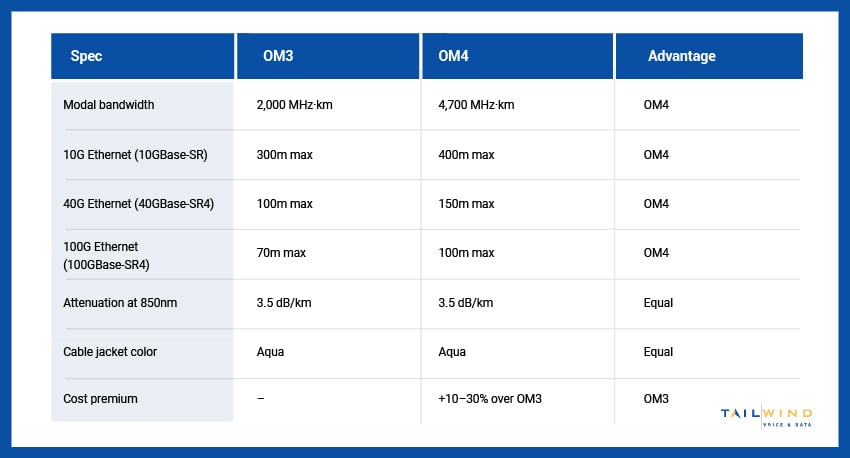
The technical difference between OM3 and OM4 is modal bandwidth – the fiber's capacity to carry information over distance. OM4 delivers significantly higher modal bandwidth than OM3, which translates directly to longer supportable distances at higher speeds.
Let’s take a closer look:
When OM3 Fiber Speed and Distance Are Suitable
OM3 fiber speed tops out at 10 Gbps for runs up to 300 meters, which is more than enough for the majority of horizontal and vertical building cabling applications. At 40G, OM3 supports runs up to 100 meters; at 100G, up to 70 meters.
For typical enterprise deployments – floor-to-floor risers, MDF-to-IDF connections, and campus backbone runs within a single building – OM3 hits all the necessary performance targets at a lower cost point than OM4. It's the workhorse of commercial fiber installation: proven, well-supported by transceiver manufacturers, and capable of handling the bandwidth demands of most enterprise environments today.
OM3 starts to show its limits in high-density data center environments, longer campus backbone runs, and infrastructure being designed to support 40G or 100G at distances beyond its rated reach.
Where OM4 Fiber Speed and Distance Pays Off
OM4's higher modal bandwidth extends supportable distances at each speed tier:
- 400m at 10G (vs. 300m for OM3)
- 150m at 40G (vs. 100m)
- 100m at 100G (vs. 70m)
While these differences don’t mean much in shorter runs, the extra headroom makes a big difference for longer backbone runs and any application pushing 40G or 100G.
OM4 has also become the standard specification for new data centers and high-density enterprise fiber deployments, even where OM3 would technically suffice. This is because the cost premium over OM3 is modest (typically 10–30% depending on the manufacturer and quantity), and installing OM4 today avoids a cabling upgrade when bandwidth demands increase – and they always do.
How To Choose Between OM3 vs OM4 Fiber Cable for Your Deployment
Both OM3 and OM4 cables deliver reliable performance within their specified limits, but making the right choice now will prevent costly rework post-deployment.
Choose OM3 when:
- Your runs are under 150 meters, and you're operating at 10G or below.
- You're working within a tightly defined budget, and your performance requirements won’t justify the OM4 cost premium.
- You're extending or matching existing OM3 infrastructure, as mixing OM3 and OM4 in a single link degrades the channel.
- You’re deploying horizontal cabling (workstation drops, access-layer connections) rather than backbone capacity.
Choose OM4 when:
- Your backbone runs exceed 100 meters, and you're operating at 40G or 100G.
- You're designing a new data center, MDF, or campus backbone intended to serve the facility for 10+ years.
- You're deploying MPO/MTP parallel optic connectors for high-density patching – OM4's bandwidth advantage is most pronounced in these high-speed, high-density scenarios.
- You want to future-proof the installation against bandwidth growth without pulling new cable.
For multi-location enterprise deployments where fiber specification needs to be consistent across every site, standardizing on OM4 is typically the right call – the incremental material cost is small relative to the labor cost of a future recabling.
If you’re still lost, TailWind’s structured cabling team is here to help you specify, install, and certify your fiber infrastructure to TIA-568 and ISO/IEC standards, with OTDR testing documentation delivered for every run.
Fiber OM3 vs OM4: Where Does OM5 Fit In?
OM5 is a wideband multimode fiber that shares OM4's 50/125µm core geometry, but is designed to support shortwave wavelength division multiplexing (SWDM) – which allows multiple wavelengths to be transmitted simultaneously over a single fiber pair. This effectively multiplies capacity without additional fiber strands.
OM5 is backward-compatible with OM4 equipment and shares the same connector types. It’s not yet necessary for enterprise backbone and campus applications where OM4 provides adequate performance, but it's worth understanding if you're designing infrastructure for a new data center or high-density campus core.
Not sure whether OM3, OM4, or OM5 is the right specification for your project? TailWind offers advisory services to help you work through the technical requirements and make the right call before the cable gets pulled.
Spec the Right Fiber Infrastructure for Your Project
Changing fiber specifications after installation is an expensive lesson. The key is to make the right call during the design stage – but specifying fiber across a nationwide infrastructure requires coordination across multiple teams, consistent standards at every location, and expert-level planning that accounts for both immediate needs and growth.
TailWind’s field services teams can simplify your enterprise cabling installation project. We coordinate multi-location rollouts from design and specification through installation, certification, and testing documentation, ensuring consistent infrastructure standards and minimizing disruption during execution.
Ready to design a fiber infrastructure that performs today and scales with your business? Get in touch with our experts.