TL;DR
-
IVR system cost in 2026 ranges from effectively zero when bundled into an existing cloud phone platform to $50,000 or more for a custom on-premises build, driven mostly by your deployment model.
-
IVR pricing splits by deployment model: cloud IVR at $15 to $150 per user monthly, contact center (CCaaS) platforms at $60 to $200 per agent, and on-premises hardware from roughly $10,000 upfront.
-
Beyond the monthly fee, budget for setup, professional prompt recordings, network readiness, and toll-free numbers at $5 to $25 per line each month, which vendor pricing pages rarely show.
If you've looked into purchasing an IVR system for your business, you've probably noticed that pricing is all over the map. Industry experts listed cloud-based IVR systems ranging anywhere from $15 to $150 per user monthly in 2025.1
That's not a coincidence – IVR system cost varies enormously based on deployment model, call volume, feature set, and whether you're buying a standalone IVR add-on or investing in a broader phone system platform.
In this guide, we’ll give you a clear framework for understanding what IVR actually costs in 2026, what drives price differences, and what to budget based on your business needs.
How Do The Three Deployment Models Determine IVR Pricing?
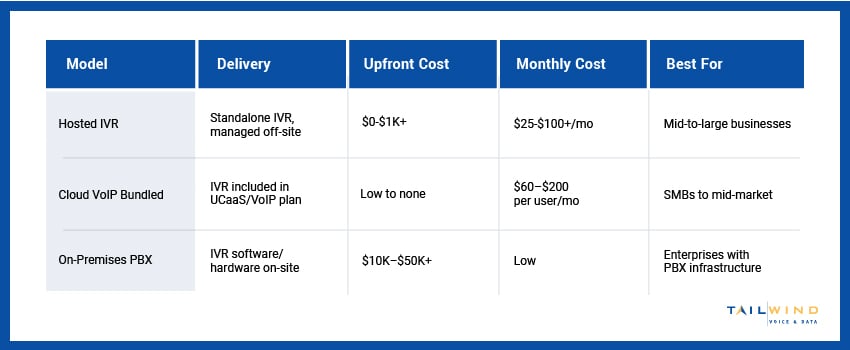
IVR pricing is shaped first by which deployment model you choose. Cloud-based IVR, contact center software, and on-premises hardware each carry a distinct cost structure, so settling on your model narrows the budget range fast.
Cloud-Based And Hosted IVR System Cost Breakdown
Cloud-based IVR bundled into a UCaaS platform is the standard choice for most businesses deploying new systems in 2026. Setup fees run from $0 to $1,000, and monthly costs land between $15 and $150 per user.1 Expect per-minute charges of $0.02 to $0.10 for toll-free and inbound routing on top of the base rate.4 If you are already on a cloud VoIP platform, IVR is often included, so the real cost is configuration, not a new license.
Contact Center Software (CCaaS) Cost Breakdown
Contact center software (CCaaS) prices per agent rather than per user, and it fits teams that need conversational AI, CRM integration, and visual IVR. Plans run from $60 to $100 per agent per month at the entry level and $100 to $200 per agent per month for premium tiers with natural language processing.2 Once pricing climbs past roughly $150 to $200 per agent, most providers switch to custom quotes, which can work in a large buyer's favor because you pay only for what you use.
Custom And On-Premises IVR System Cost Breakdown
On-premises IVR is the heaviest tier and the hardest to justify economically. Hardware and servers start around $10,000, and a full custom build covering hardware, development, PBX, and licensing can reach $50,000 or more.2 You also carry recurring maintenance and either in-house IT staff or a managed contract. This model makes sense only with existing PBX infrastructure, strict security requirements, or complex back-end integrations that cloud platforms cannot handle via API.
How Much Does IVR Cost? Realistic Budgets By Business Size
Small teams have different needs and cost profiles than enterprise deployments across multiple locations. Understanding the relationship between business size, call volume, and IVR costs can help you build a more realistic budget and avoid overpaying for capacity you don't need.
IVR System For Small Business Cost
Businesses with small teams of 20 or fewer can expect monthly expenses on a cloud IVR system to range from $150 to $1,200, depending on features and usage.1
If you're already on a cloud VoIP platform, IVR is almost certainly included – you just need to configure it. If you're on a legacy system without IVR capability, upgrading to a cloud platform delivers IVR as part of a broader modernization at a lower total cost than bolting on a standalone solution.
Mid-Market & Enterprise IVR System Cost
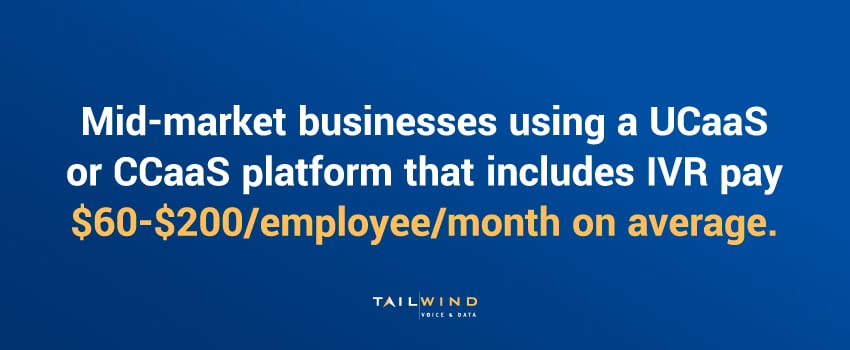
Mid-market businesses using cloud communications platforms typically pay $60-$200 per employee per month for plans that include IVR, call analytics, and CRM integrations.2
However, pricing becomes highly variable and quote-driven for large enterprises with complex routing needs, multi-location deployments, or high concurrency requirements, as they often need dedicated hosted IVR or on-premises infrastructure.
IVR cost also scales with carrier complexity. Managing IVR call routing across dozens of locations requires carrier infrastructure that's designed for the load. At TailWind, we offer carrier services to help enterprises design and manage the connectivity that multi-location IVR depends on.
6 Factors That Impact IVR Phone System Price
Regardless of which deployment model you choose, these are the variables that will have the biggest impact on your total IVR cost:
1. Call Volume
Call volume is the single largest variable in hosted IVR pricing. If your operations depend on per-minute or per-call models, run realistic volume estimates before committing to a pricing structure – costs can escalate quickly at high volume.
2. Concurrent Call Capacity
IVR ports determine how many calls your system can handle simultaneously. Not having sufficient ports during volume spikes means callers get busy signals, so make sure to size for your peak traffic.
3. Feature Complexity
Basic menu-and-route IVR is inexpensive. However, advanced features like speech recognition, NLP, self-service transaction processing, and multi-language support add licensing cost and configuration complexity.

4. Compliance Requirements
If your business is in a regulated industry like finance or healthcare, your IVR must be able to support compliance requirements like HIPAA, PCI-DSS, or GDPR. Compliant IVR systems tend to cost more due to security features like encryption and audit-ready reporting.
5. Integrations
While basic IVR can handle call routing and voicemail, advanced deployments integrate with CRM platforms, accounting systems, helpdesk software, and backend databases. Each integration adds licensing cost and requires custom configuration that increases implementation expenses.
6. Number Of Locations
Multi-site deployments multiply your IVR configuration and testing scope. Centralized IVR architectures that manage all locations from a single platform are typically more cost-efficient than running separate IVR instances per site.
What Hidden Expenses Can Affect IVR Costs?
Vendor pricing pages show monthly fees. They rarely show the full cost of ownership. Here's what frequently surprises buyers:
- Professional Setup: Complex IVR call flows require custom design and configuration support, which can range from $5,000 to over $50,000.3
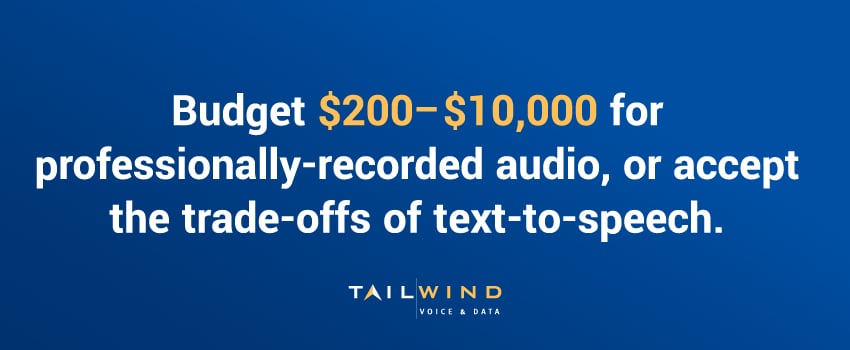
- Prompt Recording: Professional voice recordings for IVR prompts are typically not included. Budget $200–$10,000 for professionally-recorded audio,1 or accept the trade-offs of text-to-speech.
- Network Infrastructure: VoIP-based IVR is sensitive to packet loss, latency, and jitter. If your network isn't optimized for voice – QoS configuration, adequate bandwidth, low-latency routing – you'll pay for that in call quality problems regardless of IVR software quality.
- Toll-Free Numbers: If you route callers through a toll-free number, budget $5 to $25 per month per number to purchase and host it, on top of your base plan.5 High call volumes add per-minute charges beyond that, so a busy inbound line costs more than the flat number fee suggests.
The network and carrier infrastructure costs are where buyers are most often caught off guard. TailWind’s broadband aggregation and dedicated internet access solutions ensure the connectivity layer is sized and optimized for voice performance before the IVR takes its first call.
IVR System Cost FAQs
How Much Does An IVR System Cost Per Minute?
Per-minute IVR charges typically run $0.02 to $0.10 for toll-free and inbound routing, billed on top of your monthly plan. The exact rate depends on your provider, call volume, and whether calls are toll-free or local. Per-minute pricing matters most if your operations run on per-call or per-minute models, because costs climb quickly at high volume. Businesses with heavy inbound traffic should estimate realistic monthly minutes before signing, since a low headline rate can still produce a large bill across thousands of calls.
Is There A Setup Fee For A Cloud IVR System?
Cloud IVR setup fees range from $0 to $1,000, far below the cost of a custom or on-premises build. Many cloud and UCaaS platforms include basic IVR in the subscription, so if you are already on one, setup often means configuring menus rather than paying an install fee. Complex call flows that need custom design and professional configuration are the exception and can push setup costs much higher. Simple menu-and-route setups usually carry little or no upfront charge.
How Much Does IVR Cost For A Small Business?
Small businesses with teams of 20 or fewer can expect monthly cloud IVR expenses of $150 to $1,200, depending on features and usage. If you already run a cloud VoIP platform, IVR is almost certainly included, so you only need to configure it. Businesses on a legacy system without IVR usually save more by upgrading to a cloud platform than by bolting a standalone IVR onto old infrastructure. Feature depth, call volume, and the number of users drive where you land in that range.
How Much Does An On-Premises IVR System Cost?
On-premises IVR is the most expensive model. Hardware and servers start around $10,000, and a full custom deployment covering hardware, development, PBX, and licensing can reach $50,000 or more. Beyond the initial outlay, you pay for ongoing maintenance and either in-house IT staff or a managed contract. This model suits large businesses with very high call volumes, complex routing, or strict security needs. For most organizations, a cloud IVR delivers the same core function at a fraction of the upfront cost.
What Is The Difference Between IVR Pricing And Contact Center (CCaaS) Pricing?
Standalone cloud IVR is priced per user per month, generally $15 to $150, with optional per-minute charges. Contact center software (CCaaS) is priced per agent per month, usually $60 to $200 or more, and bundles IVR with agent tools like queuing, analytics, CRM integration, and conversational AI. You pay more per seat with CCaaS, but you get a full contact center platform rather than a routing menu. Choose based on whether you need call routing alone or a broader agent-facing system.
Is IVR Included In A Cloud Phone System Or Does It Cost Extra?
On most cloud VoIP and UCaaS platforms, basic IVR is included in the plan, so there is no separate license to buy. You configure menus and routing yourself through the provider's control panel. Extra costs appear when you add advanced capabilities such as speech recognition, natural language processing, self-service transactions, or multi-language support, which carry additional licensing and configuration fees. Standalone IVR add-ons for legacy phone systems are the pricier route, which is why upgrading to a cloud platform often lowers the total cost.
How Can A Business Reduce Its IVR System Costs?
The fastest way to cut IVR costs is to bundle it into a cloud platform you already use rather than buying a standalone system. Recording prompts in-house instead of paying for professional voice talent lowers upfront spend, though text-to-speech is a cheaper trade-off. Right-sizing concurrent call capacity to your actual peak traffic avoids paying for unused ports. Estimating realistic call volume before committing keeps per-minute charges in check, and centralizing multi-site IVR on one platform costs less than running separate instances per location.
What Should An Interactive Voice Response System Cost Your Business?
IVR system cost in 2026 ranges from effectively zero (when it’s bundled with your existing cloud phone platform) to tens of thousands of dollars for enterprise on-premises deployments. The right answer for your business sits somewhere on that spectrum and depends entirely on your call volume, feature requirements, and the infrastructure you're building on.
Need help understanding the full cost equation for your IVR system? TailWind can simplify it for you. We’ll handle infrastructure assessment and optimization, coordinating with your carrier to right-size capacity and ensuring your network is ready before IVR goes live.
Whether you're planning a first IVR deployment or troubleshooting a system that isn't performing, get in touch with our team – we'll make sure the foundation is right.
Sources: