Most business internet connections are sold on their download speed – the number that sounds most impressive in a sales pitch. But for modern business operations, upload speed matters just as much, and for many applications, it matters more.
That’s because business computing now lives in the cloud. According to Flexera’s 2026 State of the Cloud report, 73% of all organizations use a hybrid cloud model, with 56% of workloads currently in public cloud.¹ Every one of those workloads depends on sending data out, not just pulling it in.
Choosing the right connection for that kind of two-way demand is one of the more important infrastructure decisions a business makes in 2026. In this blog, we’ll break down what symmetrical internet is, why your business needs it, and how to choose the right plan for your connectivity strategy.
TL;DR
-
Symmetrical internet delivers identical upload and download speeds, unlike asymmetrical cable and DSL plans where upload often runs 10 to 20 times slower than the advertised download speed.
-
Businesses running cloud platforms, VoIP, video conferencing, remote work, off-site backups, and point-of-sale systems need strong upload performance, because these workloads send as much data as they receive.
-
Fiber is the standard for symmetrical business connectivity because it carries data as light with no built-in asymmetry, which makes symmetrical gigabit internet a common offering in serviceable areas.
What Is Symmetrical Internet?
Symmetrical internet is a connection where upload and download speeds are identical. For example, a 500 Mbps symmetrical internet connection will deliver 500 Mbps both ways – data flows to you and from you at the same rate.
This is different from the asymmetrical connections most residential and business broadband plans still deliver, where download speeds are advertised prominently, and upload speeds are often 10 to 20 times slower.
In these plans, a 500 Mbps cable service tier might only deliver 20 Mbps upload. While that’s fine for casual browsing, it’s a serious bottleneck for business applications that depend on sending data, not just receiving it.
Asymmetrical vs Symmetrical Internet Speeds: How Do They Compare?
The clearest way to understand symmetrical speed internet is to compare it directly against the asymmetrical model most consumers and legacy business plans still use:
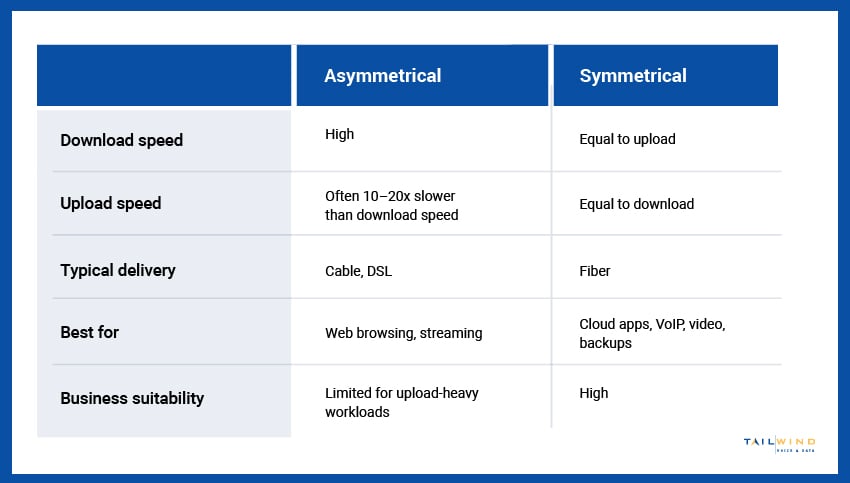
Asymmetrical connections were designed around a consumption model of internet use – downloading web pages and streaming video. Business use today looks fundamentally different, which is exactly why symmetrical bandwidth has become a business necessity rather than a nice-to-have.
Why Your Business Needs A Symmetrical Internet Connection
Modern business operations depend on sending as much data as they receive. Some of the applications driving this shift are:
Cloud & SaaS Platforms
Uploading files to cloud storage, syncing data with CRM and ERP systems, and backing up to the cloud all require strong upload performance.
As more core software moves off local servers and into the cloud, routine work like saving a document or sharing a file becomes an upload event. On an asymmetrical connection, those constant small transfers pile up and slow the applications your team relies on all day.
VoIP & Video Conferencing
Every participant on a call is both sending and receiving audio and video simultaneously. Weak upload bandwidth degrades your outbound video and audio quality for everyone else on the call.
The frustrating part is that the problem is invisible on your end, since your incoming feed looks fine while the people you're talking to see you freeze, pixelate, or drop out. Symmetrical bandwidth keeps both directions of the conversation clear.
Remote & Hybrid Work
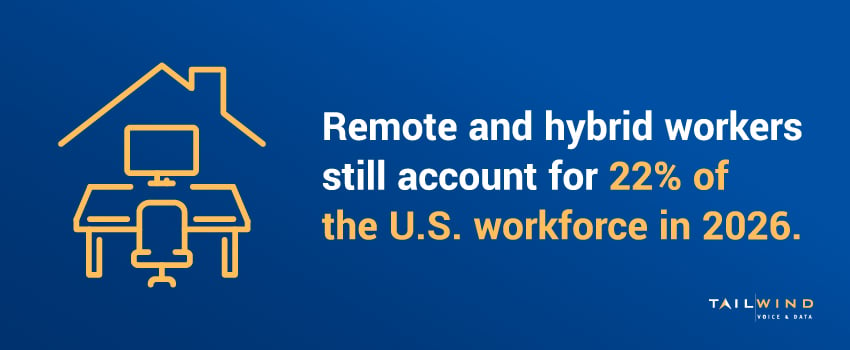
Remote and hybrid workers still account for 22% of the U.S. workforce in 2026.2 These employees connect to VPNs, upload large files, and run video calls from home or branch offices, and they all depend on adequate upload capacity.
When upload capacity falls short, collaboration slows for everyone, regardless of how fast their download speeds look.
Data Backup & Disaster Recovery
Backing up servers and systems to off-site or cloud storage is an upload-heavy process, and asymmetrical connections make this painfully slow. Large nightly backups can run past their window and spill into business hours, competing with live traffic when the network is busiest.
Strong, symmetrical upload speeds keep backups on schedule and shorten the recovery window when you actually need to restore.
Point-of-Sale & Transaction Processing
Retail and hospitality businesses sending transaction data to payment processors and back-office systems need consistent upload performance at every location. A slow or unstable upload path shows up directly at the register as declined authorizations, lagging approvals, and longer lines.
Reliable symmetrical bandwidth keeps the transactions flowing and protects the customer experience at the point that matters most.
Symmetrical Fiber Internet: Why Fiber Is The Standard
Symmetrical fiber internet is the most common way businesses access true symmetrical bandwidth, and there's a technical reason for that. Fiber optic cable transmits data as light, with no inherent asymmetry in how upload and download signals travel through the medium.
Cable and DSL technologies, by contrast, were engineered around asymmetrical use from the start – their underlying physical layer often makes true symmetry difficult or impossible to deliver at scale.
That’s why symmetrical gigabit internet (1 Gbps upload and download) is now a standard offering from fiber providers in serviceable areas. Meanwhile, cable providers still cap upload speeds well below their advertised download tiers, even on symmetrical cable internet products marketed as an upgrade.

How To Choose The Right Symmetrical Internet Plans For Your Business
When evaluating symmetrical internet plans, the considerations that matter most for business connectivity include:
- Actual vs. Advertised Speed: Confirm the plan is genuinely symmetrical, not just "improved" upload on an otherwise asymmetrical product.
- SLA Backing: Business-grade symmetrical connections should come with uptime and repair-time guarantees, not the best-effort terms of residential plans.
- Bandwidth Headroom: Size your connection for peak simultaneous usage across cloud apps, VoIP, and video conferencing, not just average daily use.
- Multi-Location Consistency: Standardizing on symmetrical bandwidth across every location prevents the inconsistent performance that comes from mixing connection types.
At TailWind, we built our business fiber services to deliver symmetrical fiber connectivity for exactly these requirements. Plus, our broadband aggregation team sources the right symmetrical connection at every location for multi-site enterprises – under one relationship, with consistent performance standards across the board.
Symmetrical Internet FAQs
What Is Symmetrical Internet?
Symmetrical internet is a connection that delivers the same speed for uploads and downloads. On a 500 Mbps symmetrical plan, data moves to and from your network at 500 Mbps in both directions. Most residential and many business broadband plans work differently: they advertise a high download speed while upload runs 10 to 20 times slower. For businesses that constantly send data to cloud platforms, video calls, and backup systems, matching speeds remove the upload bottleneck that asymmetrical plans create.
What Is The Difference Between Symmetrical And Asymmetrical Internet?
The difference comes down to upload speed. An asymmetrical connection prioritizes downloads, so a 500 Mbps cable tier might offer only 20 Mbps upload. A symmetrical connection gives you equal speed in both directions. Asymmetrical plans were built around a consumption model of internet use, like loading web pages and streaming video. That design works for casual browsing, but it becomes a serious constraint once your business relies on cloud apps, VoIP, and remote access that send as much data as they receive.
Why Do Businesses Need Symmetrical Internet?
Businesses need symmetrical internet because most daily work now involves sending data, not just receiving it. Cloud storage, CRM and ERP syncing, video conferencing, VPN connections, off-site backups, and point-of-sale transactions all depend on upload capacity. With 73% of organizations running a hybrid cloud model, even routine tasks like saving a document become upload events. On an asymmetrical connection, those transfers compete for a narrow upload path, and the applications your team uses all day start to slow down.
How Does Upload Speed Affect Video Calls And VoIP?
Upload speed determines how clearly other people see and hear you. Every participant on a call sends and receives audio and video at the same time, so weak upload bandwidth degrades your outgoing feed. The tricky part is that you won’t notice it yourself. Your incoming video looks fine, while the people on the other end watch you freeze, pixelate, or drop out. A symmetrical connection keeps both directions of the conversation clear.
Why Do Remote And Hybrid Workers Need Strong Upload Speeds?
Remote and hybrid employees, who still make up 22% of the U.S. workforce in 2026, send a constant stream of data back to the business. They connect through VPNs, upload large files, and join video calls from home or branch offices. All of that depends on upload capacity. When that capacity falls short, collaboration slows for the whole team, no matter how fast download speeds look on paper.
How Does Symmetrical Internet Help With Data Backup And Disaster Recovery?
Backing up servers and systems to the cloud or an off-site location is an upload-heavy job, so it benefits directly from symmetrical speeds. On an asymmetrical connection, large nightly backups can run past their window and spill into business hours, where they compete with live traffic at the busiest time of day. Fast, matching upload speeds keep backups on schedule and shorten the recovery window when you need to restore your data.
Why Is Fiber The Best Option For Symmetrical Internet?
Fiber is the standard for symmetrical internet because it transmits data as light, with no built-in asymmetry between upload and download signals. Cable and DSL were engineered around asymmetrical use from the start, and their physical layer often makes true symmetry difficult or impossible at scale. That’s why symmetrical gigabit internet (1 Gbps in both directions) is now a standard fiber offering in serviceable areas, while cable providers still cap upload speeds well below their download tiers.
How Do I Choose The Right Symmetrical Internet Plan For My Business?
Start by confirming the plan is genuinely symmetrical, not an asymmetrical product with “improved” upload. Then look for SLA backing, with uptime and repair-time guarantees rather than best-effort terms. Size the connection for peak simultaneous usage across cloud apps, VoIP, and video conferencing instead of average daily use. If you operate multiple sites, standardize on symmetrical bandwidth at every location to avoid the inconsistent performance that comes from mixing connection types.
Ready To Upgrade To Symmetrical Internet?
Symmetrical internet isn't a premium add-on for any business running cloud applications, VoIP, video conferencing, or remote work at scale. It's foundational infrastructure. The gap between a connection that only downloads well and one that performs equally in both directions shows up daily in call quality, backup times, and application responsiveness.
Ready to get started with symmetrical internet? Whether you're upgrading a single location or standardizing symmetrical connectivity across a multi-site portfolio, TailWind backs every deployment with boots-on-the-ground support and nationwide field services – so your connectivity is sourced, installed, and maintained consistently at every site.
Get in touch today, and let's build a connection that performs the way your business actually works.
Sources: